
I’ve been spending quite a bit of time lately reading through Grandpa Percy’s handwritten recollections of growing up on the Copithorne ranch at Jumping Pound.
He wrote about riding to school, working around the ranch, and the ordinary happenings of everyday life. I’ve particularly enjoyed the little stories that probably didn’t seem terribly remarkable to him at the time.
One of them made me laugh out loud.
It involves his younger brother George, a red cow, and a galvanized washtub.
But first, a little about Grandpa’s school days.
Grandpa rode three miles to school on horseback. I grew up hearing stories about my mother and other members of the family riding horses to school, and I always thought it was terribly unfair that I had to walk.
Of course, I lived in the city.
Now that I’m older, I can appreciate that riding three miles in thirty-below weather, particularly when you had a creek to cross, might not have been quite as wonderful as I imagined.
But still. They had horses.
Grandpa described his little log schoolhouse with its red roof and what he called its “central heating”:
Some cold days were experienced in the wintertime. After a three-mile ride to the little log schoolhouse with a red roof and fitted up with central heating, which consisted of a box stove in the center of the school and the pipes running along to one end where the chimney was.
Apparently, the central heating wasn’t entirely reliable.
Grandpa continued:
One cold day in the middle of class, the pipes all fell down except about three lengths above the stove. Luckily, a damper was in one of these pipes. And Jimmy Bateman had presence of mind to turn the damper, which stopped the flames from reaching the ceiling.
I imagine that caused a little excitement.
Grandpa also remembered an occasion when his horse took exception to a piece of paper lying on the ground:
Horse shied at a piece of paper and I was dumped into a bush when I was already late for school, which meant a penalty, a lost recess, or a piece of poetry to memorize.
Fortunately, his explanation was accepted.
When I arrived at school, my story was satisfactory to my relief. But everybody spent the noon hour picking up all the papers which were discarded from lunch papers.
I rather enjoyed that little detail. Grandpa was relieved to escape punishment for being late, but he still remembered having to spend the noon hour picking up papers!
And after school, there were cows to milk.
Grandpa wrote:
After arriving home from school, we were always faced with a dozen cows or so to milk. These cows were milked in a small round corral, no barn or stalls in those days. But each cow had a preferred place in that corral before she would allow you to milk her.
I can’t imagine trying to milk a dozen cows outside in an Alberta winter, particularly when each cow had her own ideas about where she was prepared to stand.
Grandpa built himself a barn when he was about twenty years old. After reading about those afternoons in the corral, I can certainly understand why a barn would have been a welcome addition to the ranch.
And that brings us to one particular cow.
One long-horned red cow liked to stand beside an open shed where a Democrat and also a big galvanized wash tub was stored.
For anyone wondering, a Democrat was a type of horse-drawn carriage.
Now, Grandpa’s younger brother George was apparently still too young to help with the milking, but that didn’t mean he couldn’t find something to do.
George had the bright idea of tying the cow’s tail to the handle of the washtub so he could take a ride around the corral.
And then, in Grandpa’s words:
All hell broke loose when the cow was poked into motion and everybody in the corral was reaching for the top rail in the fence.
I can just picture it.
A long-horned red cow charging around the corral, a galvanized washtub rattling along behind her, and everyone scrambling for the fence.
And George, who had only wanted a ride.
Grandpa finished the story with wonderful understatement:
Luckily George’s twine was not very permanent. And after a couple of rounds, the tub fell off.
I laughed out loud when I read that.
I also found myself thinking about how different life must have been for those children. Riding horses to school, milking cows in an open corral, and finding their entertainment in whatever happened to be lying around the ranch.
I remember hearing that Grandpa, as the eldest child, had to get up in the mornings and break the ice on the household water buckets.
Years later, I lived in that same old ranch house, and I can certainly attest to how cold it could get.
But at least we had running water. And considerably better central heating than Grandpa’s schoolhouse!
The house might have been cold on a winter morning, but it was never so cold that we had ice forming on the water buckets. I can’t imagine waking up to that every day.
And then there’s this photograph I found among Grandma Edna’s things.
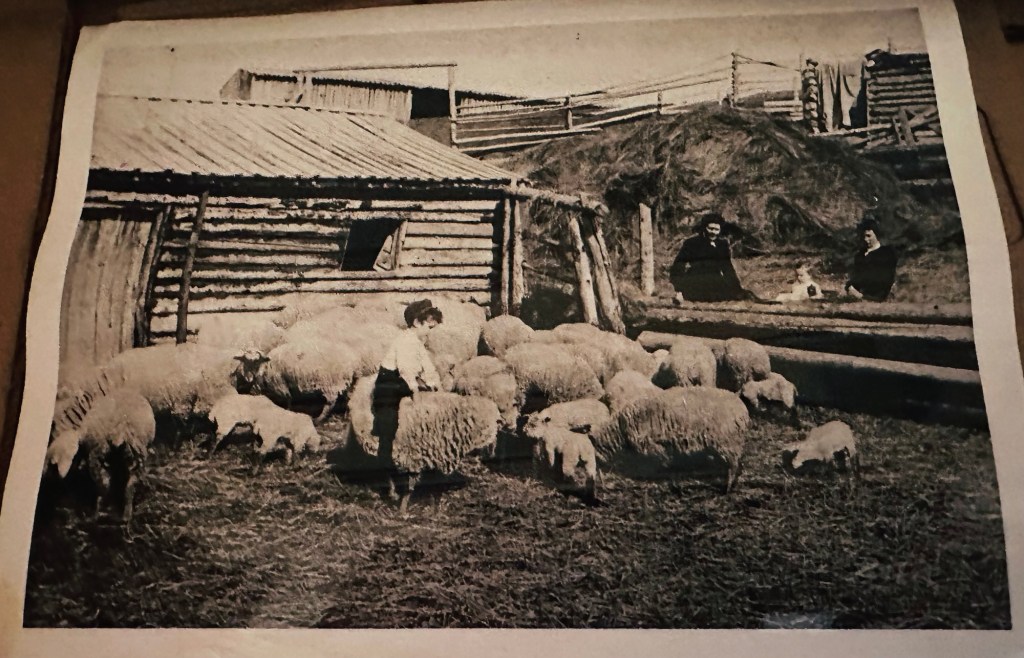
On the back, Grandma identified Grandpa Percy as the little boy riding the sheep, along with Aunt Ada Nicoll, Margy Copithorne, and Mrs. Richard Copithorne, Grandpa’s mother Sophia.
Apparently, George wasn’t the only Copithorne boy who found creative ways to entertain himself with the livestock.
I think perhaps those two brothers had more in common than Grandpa let on.
And I still wonder what that poor red cow thought of the whole business.
Photograph: Percy Copithorne riding a sheep, with Aunt Ada Nicoll, Margy Copithorne, and Mrs. Richard (Sophia) Copithorne. Identification handwritten on the reverse by Edna Copithorne. Family collection.

