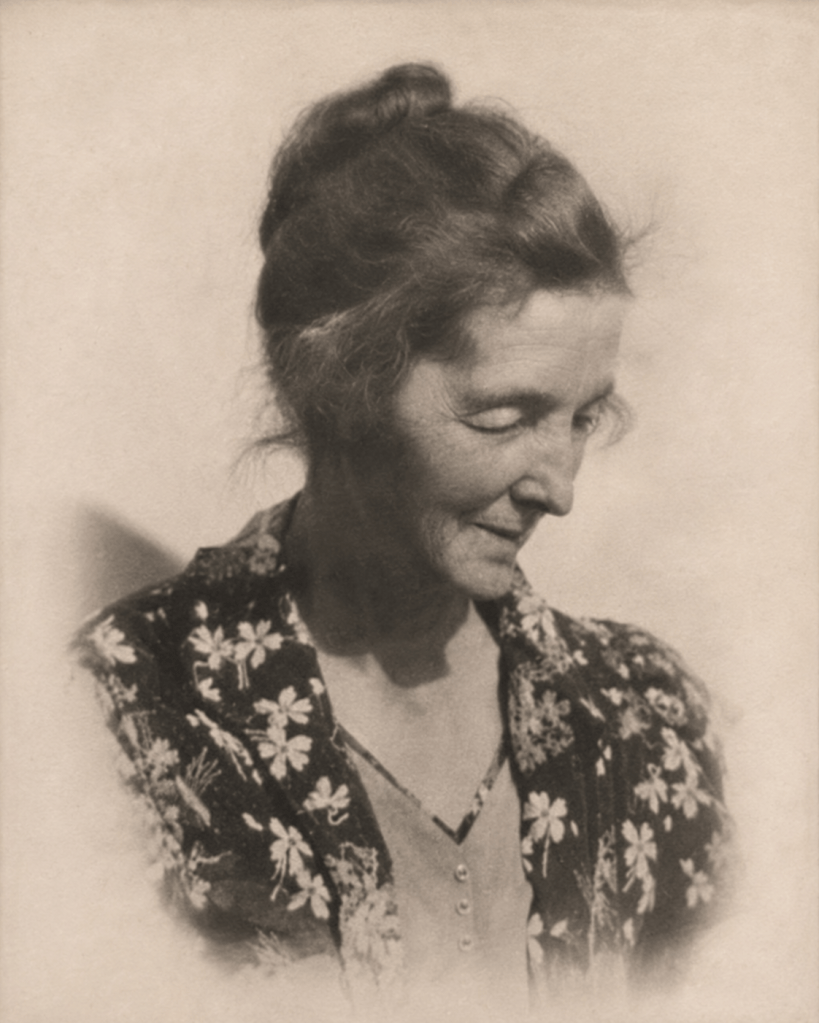
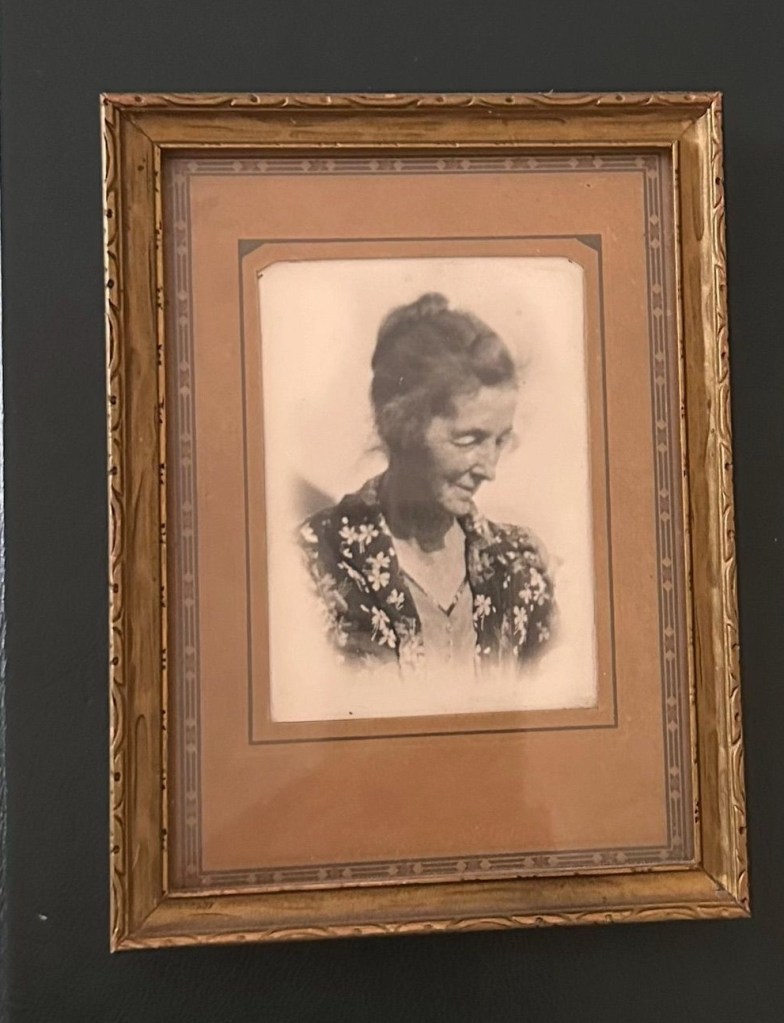
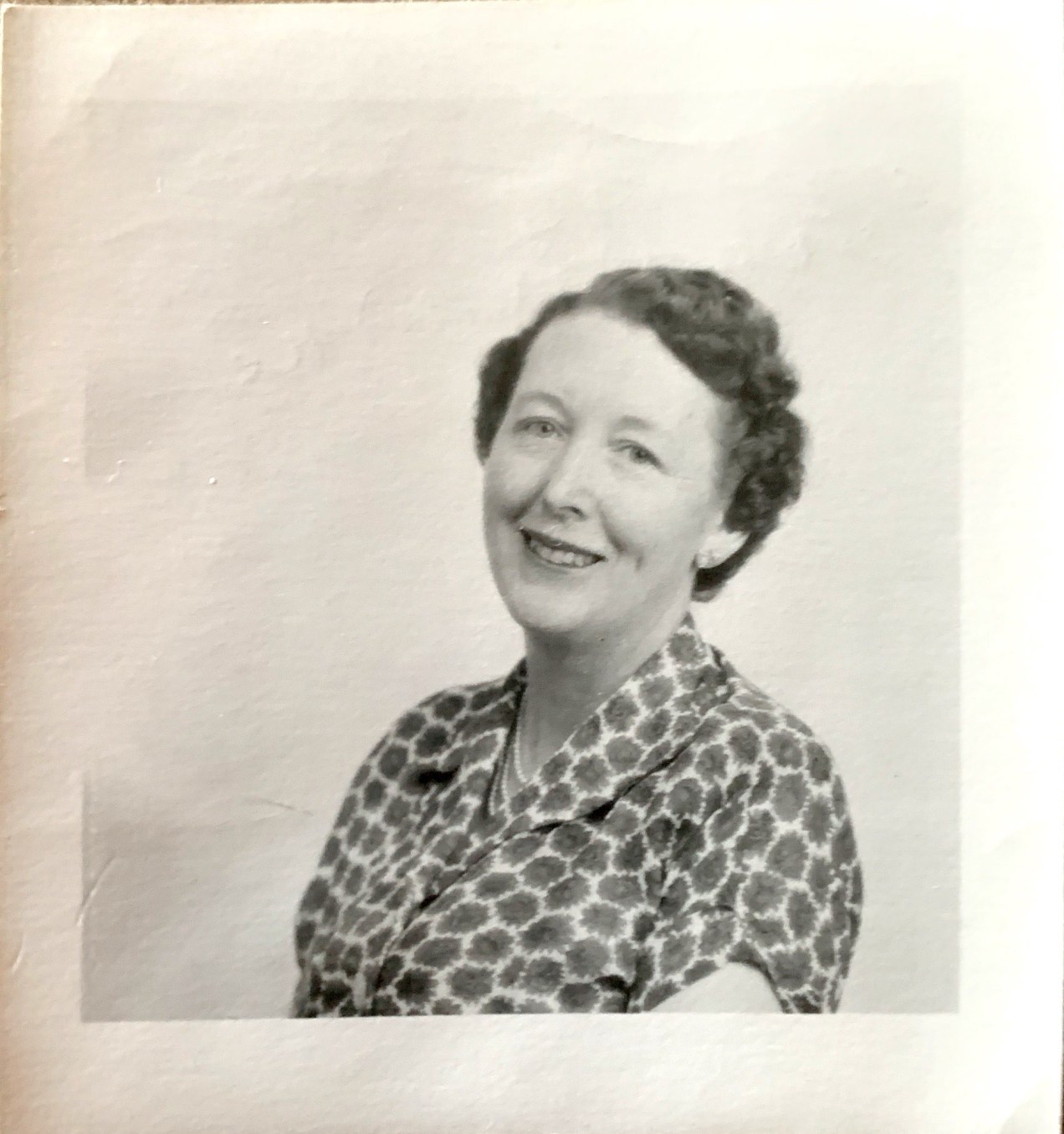
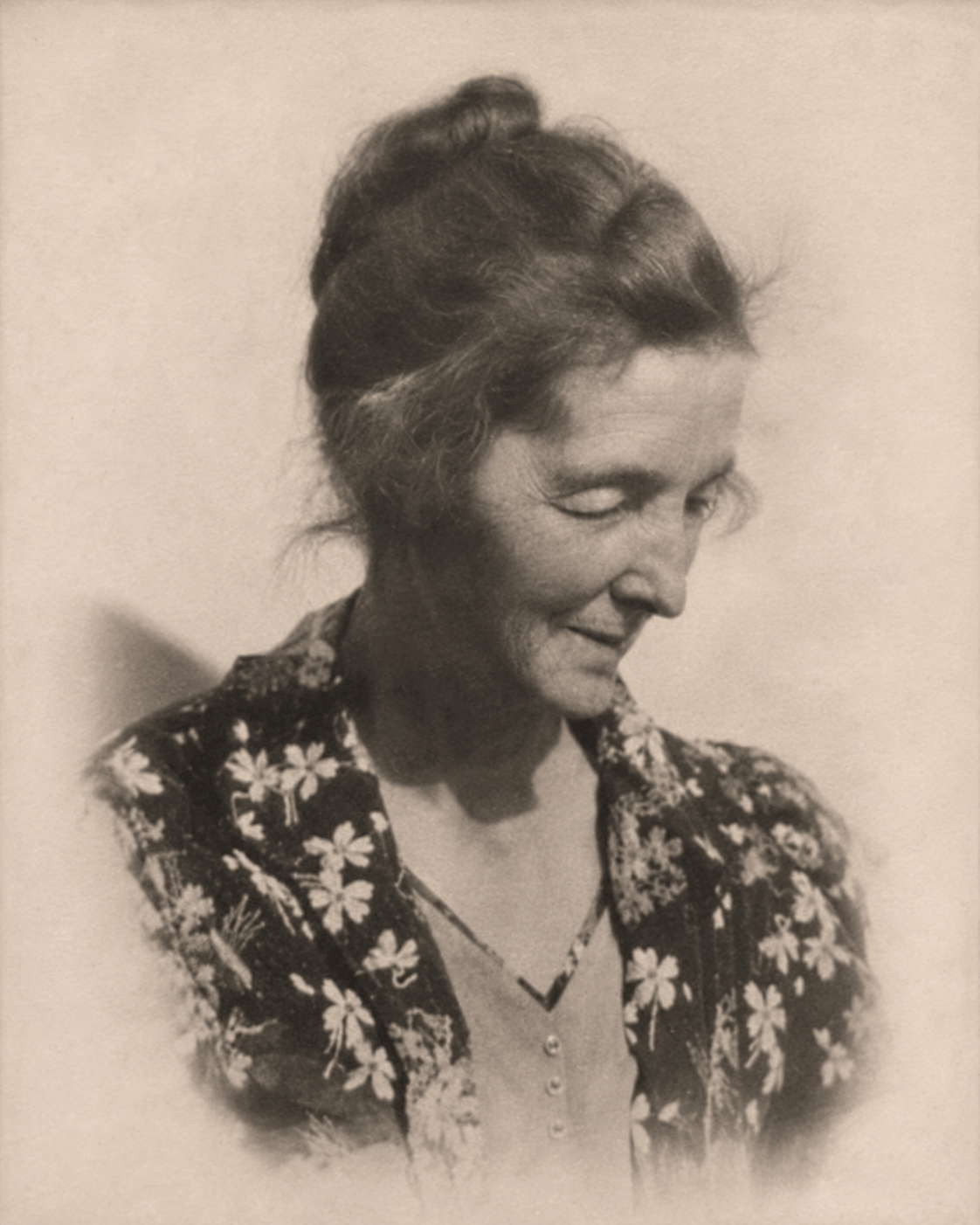
Martha Brown looking down with a gentle, loving expression.
Alberta History

The Rest of the Story

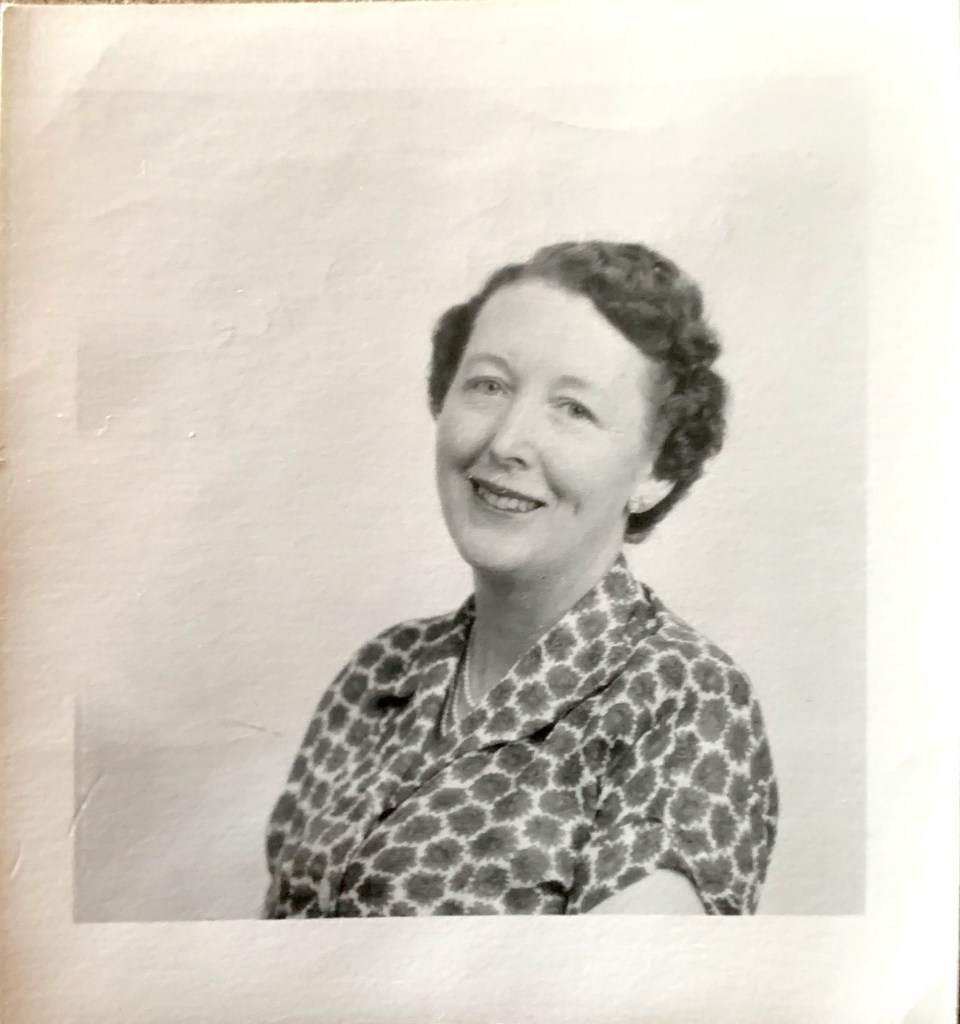
A couple of years ago, I came across an old photograph of a woman whose face immediately caught my attention.

At the time, I didn’t know who she was. I hadn’t yet turned the photograph over to discover that her name was written on the back. What caught my attention was the expression on her face.

There was such a softness about her, such a look of love and tenderness.

I was going through a time in my life when I quite desperately wished I had a grandma. Someone who loved me simply because I was me. I remember looking at that photograph and thinking how lovely it would be to have someone look at me like that.

As it turned out, the woman in the photograph was my great-grandmother, Martha Brown.

She has had a place on my mantel ever since. I look at her every day, and there is something about having her there that I find particularly comforting.

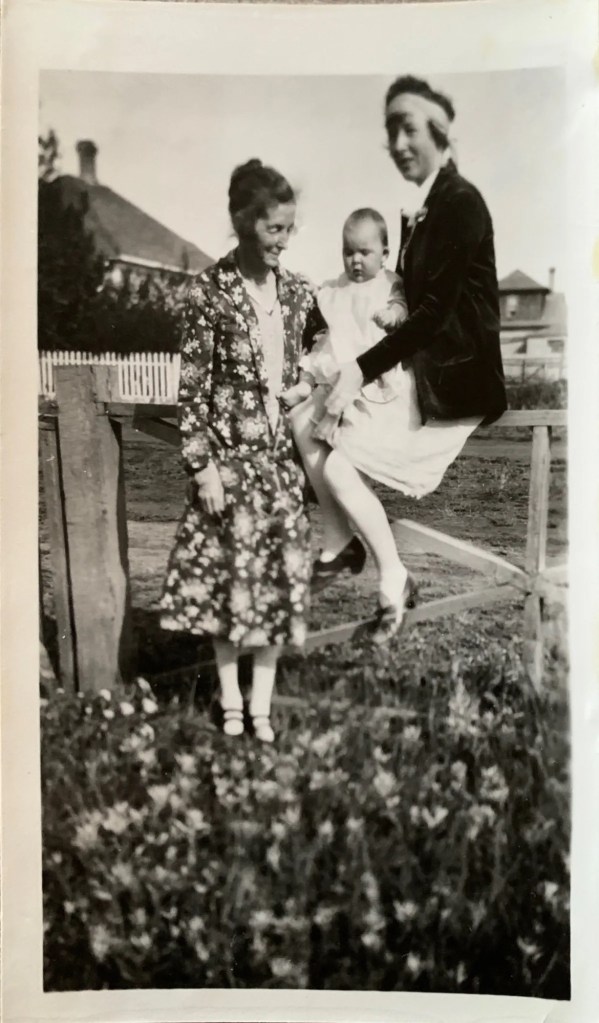
I have often wondered what she was looking at.

And then, the other day, while looking through some of my previous blog posts, I discovered the rest of the photograph. It had been right there in front of me all along. I had even posted it myself!

There was Martha, wearing the same lovely floral dress, looking down at her first grandchild, Aileen. Sitting on the gate beside her was her youngest daughter, Edna, my grandma.

I wasn’t mistaken about the expression on her face after all.

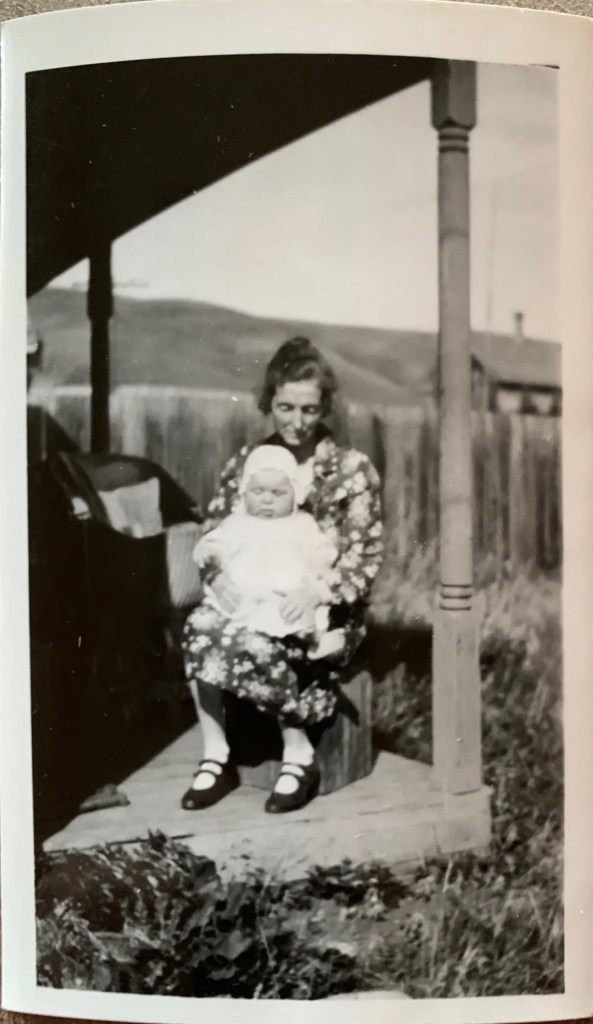
There is another photograph, apparently taken that same day, of Martha sitting on a porch with Aileen on her lap.

Aileen was born on November 8, 1928, which would suggest these photographs were taken sometime in 1929. Martha would have been in her early fifties.

From what I have learned about Martha’s life, it was not an easy one. My understanding is that there was always food, but there was very little money for luxuries, even by the standards of the day. Martha made her own clothes and worked hard throughout her life.

And yet, look at her face.

There isn’t a material possession I can think of that could replace the feeling of being looked at with that much love.

As I have been learning more about Martha, I have inevitably learned about some of the hardships she experienced. But I am particularly grateful for these photographs because they remind me that, in amongst those hardships, there was still joy.

Martha died on September 29, 1935, at the age of 58. She lived long enough to see her youngest daughter become a mother herself, with the birth of Sheila on March 13 of that year.

Among my collection of historical documents is a handwritten poem attributed to Martha’s husband, Frank, entitled Lamentation for my Dear Wife.

In it are the lines:

the moon may still her radiance shed
just as on nights of yore
but what avails when hope is dead
and my Dear wife ill see no more

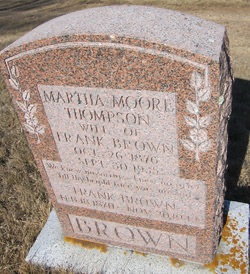
And on Martha’s gravestone are the words:

We knew no sorrow – Knew no grief
Till thy bright face was missed.

I was thinking last night about how remarkable it is that I am sitting in a house where Martha once sat. Where Grandma nursed her babies, where Mom lay recovering from polio, and where both Grandma and Grandpa died.

How much life has been lived within these walls.

I wonder what Martha would think if she knew that, nearly a hundred years after someone took a photograph of her enjoying her first grandchild, her great-granddaughter would be sitting here finding comfort in that very same moment.

She had no idea that a little bit of her joy that day would travel quite so far.

And I am so very grateful that it did.

Standard
Alberta History

Beyond the Sheep: An Ordinary Afternoon a Century Ago

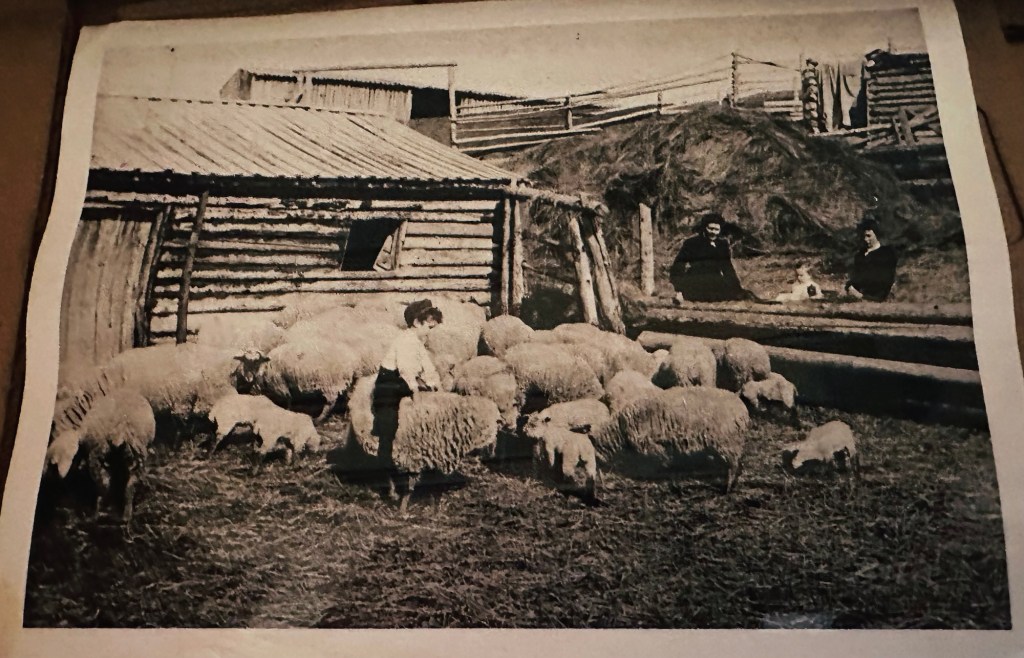
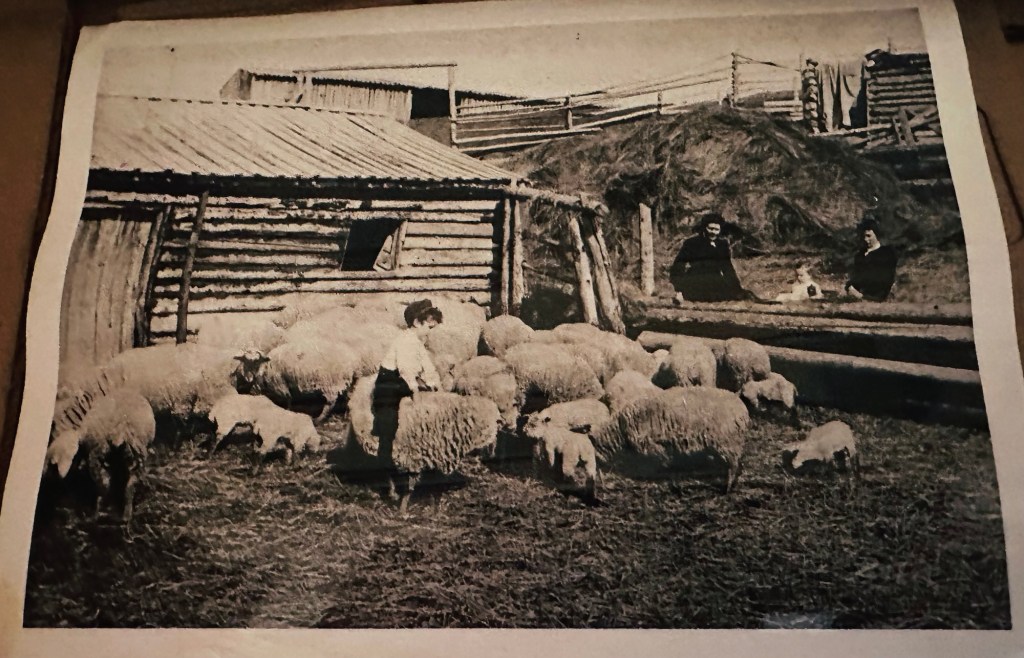
I’ve had a photograph of my grandfather riding a sheep hanging on our family photo wall for years.

It’s one of those pictures that always makes me laugh. There’s Grandpa Percy, just a little boy, sitting on a sheep as though this were a perfectly reasonable thing to do.

And for all those years, that’s pretty much all I saw.

The boy on the sheep.

Recently, while putting together a story about Grandpa and his younger brother George, I took another look at the photograph. This time, I found myself paying attention to the people around him.

And I realized I’d been overlooking something rather wonderful.

The women.

On the back of the photograph, Grandma Edna had identified Aunt Ada Nicoll, Margy Copithorne, and Mrs. Richard Copithorne, who was Grandpa’s mother, Sophia.

Margy was Grandpa’s younger sister.

And Sophia was only nineteen when Grandpa was born.

I’ve always thought of Sophia as one of those formidable women of the early ranching days. The Wild West, horses, hard winters, and all the things that went along with raising a family on a ranch at the turn of the century.

And there she was.

Just a young mother, spending an afternoon watching her little boy ride a sheep.

As one does.

It struck me how familiar the scene was.

I remember standing around with other mothers while our children played, chatting about whatever happened to be going on in our lives, occasionally looking over to see what the children were getting up to.

Our children were usually on playground equipment rather than livestock, but otherwise, I could recognize the moment.

Women together. Children playing. An ordinary afternoon.

More than a century between us, and yet suddenly the distance didn’t seem quite so great.

But the photograph had another surprise waiting for me.

I became curious about Aunt Ada Nicoll. Who was she, exactly? And how was she related to the family?

A little digging led me to the 1891 Canadian census, where I found two little girls living with their parents, George and Jane Wills, on Wolfe Island, Ontario.

Sophia, aged eleven.

And Ada, aged five.

They were sisters.

The two women in Grandpa’s photograph had grown up together, years before either of them appeared in that ordinary afternoon on a ranch west of Calgary.

And suddenly I liked the photograph even more.

I don’t know what Sophia and Ada were talking about that day. I don’t know whether they were laughing at Percy, keeping an eye on him, or simply enjoying one another’s company.

But now I know they had a lifetime of family history between them.

And I found myself wondering about them in a way I never had before.

So much of what we remember about the past concerns the big things. The hardships, the accomplishments, the families and ranches people built.

And those stories matter.

But so do these little moments.

The conversations between sisters. The afternoons spent together. The children getting into mischief.

The ordinary things that don’t generally make it into history books.

For years, I looked at that photograph and saw my grandfather riding a sheep.

I’m awfully glad I finally looked beyond the sheep.

Standard
happiness

Of Sheep, Cows, and Copithorne Boys

I’ve been spending quite a bit of time lately reading through Grandpa Percy’s handwritten recollections of growing up on the Copithorne ranch at Jumping Pound.

He wrote about riding to school, working around the ranch, and the ordinary happenings of everyday life. I’ve particularly enjoyed the little stories that probably didn’t seem terribly remarkable to him at the time.

One of them made me laugh out loud.

It involves his younger brother George, a red cow, and a galvanized washtub.

But first, a little about Grandpa’s school days.

Grandpa rode three miles to school on horseback. I grew up hearing stories about my mother and other members of the family riding horses to school, and I always thought it was terribly unfair that I had to walk.

Of course, I lived in the city.

Now that I’m older, I can appreciate that riding three miles in thirty-below weather, particularly when you had a creek to cross, might not have been quite as wonderful as I imagined.

But still. They had horses.

Grandpa described his little log schoolhouse with its red roof and what he called its “central heating”:

Some cold days were experienced in the wintertime. After a three-mile ride to the little log schoolhouse with a red roof and fitted up with central heating, which consisted of a box stove in the center of the school and the pipes running along to one end where the chimney was.

Apparently, the central heating wasn’t entirely reliable.

Grandpa continued:

One cold day in the middle of class, the pipes all fell down except about three lengths above the stove. Luckily, a damper was in one of these pipes. And Jimmy Bateman had presence of mind to turn the damper, which stopped the flames from reaching the ceiling.

I imagine that caused a little excitement.

Grandpa also remembered an occasion when his horse took exception to a piece of paper lying on the ground:

Horse shied at a piece of paper and I was dumped into a bush when I was already late for school, which meant a penalty, a lost recess, or a piece of poetry to memorize.

Fortunately, his explanation was accepted.

When I arrived at school, my story was satisfactory to my relief. But everybody spent the noon hour picking up all the papers which were discarded from lunch papers.

I rather enjoyed that little detail. Grandpa was relieved to escape punishment for being late, but he still remembered having to spend the noon hour picking up papers!

And after school, there were cows to milk.

Grandpa wrote:

After arriving home from school, we were always faced with a dozen cows or so to milk. These cows were milked in a small round corral, no barn or stalls in those days. But each cow had a preferred place in that corral before she would allow you to milk her.

I can’t imagine trying to milk a dozen cows outside in an Alberta winter, particularly when each cow had her own ideas about where she was prepared to stand.

Grandpa built himself a barn when he was about twenty years old. After reading about those afternoons in the corral, I can certainly understand why a barn would have been a welcome addition to the ranch.

And that brings us to one particular cow.

One long-horned red cow liked to stand beside an open shed where a Democrat and also a big galvanized wash tub was stored.

For anyone wondering, a Democrat was a type of horse-drawn carriage.

Now, Grandpa’s younger brother George was apparently still too young to help with the milking, but that didn’t mean he couldn’t find something to do.

George had the bright idea of tying the cow’s tail to the handle of the washtub so he could take a ride around the corral.

And then, in Grandpa’s words:

All hell broke loose when the cow was poked into motion and everybody in the corral was reaching for the top rail in the fence.

I can just picture it.

A long-horned red cow charging around the corral, a galvanized washtub rattling along behind her, and everyone scrambling for the fence.

And George, who had only wanted a ride.

Grandpa finished the story with wonderful understatement:

Luckily George’s twine was not very permanent. And after a couple of rounds, the tub fell off.

I laughed out loud when I read that.

I also found myself thinking about how different life must have been for those children. Riding horses to school, milking cows in an open corral, and finding their entertainment in whatever happened to be lying around the ranch.

I remember hearing that Grandpa, as the eldest child, had to get up in the mornings and break the ice on the household water buckets.

Years later, I lived in that same old ranch house, and I can certainly attest to how cold it could get.

But at least we had running water. And considerably better central heating than Grandpa’s schoolhouse!

The house might have been cold on a winter morning, but it was never so cold that we had ice forming on the water buckets. I can’t imagine waking up to that every day.

And then there’s this photograph I found among Grandma Edna’s things.

On the back, Grandma identified Grandpa Percy as the little boy riding the sheep, along with Aunt Ada Nicoll, Margy Copithorne, and Mrs. Richard Copithorne, Grandpa’s mother Sophia.

Apparently, George wasn’t the only Copithorne boy who found creative ways to entertain himself with the livestock.

I think perhaps those two brothers had more in common than Grandpa let on.

And I still wonder what that poor red cow thought of the whole business.

Photograph: Percy Copithorne riding a sheep, with Aunt Ada Nicoll, Margy Copithorne, and Mrs. Richard (Sophia) Copithorne. Identification handwritten on the reverse by Edna Copithorne. Family collection.

Standard
Alberta History

Just One Broken Saucer

I have spent quite a bit of time reading old letters and family stories over the years, and every once in a while, something catches my attention that probably wouldn’t have seemed particularly remarkable to the person writing it.

In this case, it was a saucer.

A broken saucer, to be precise.

In August 1954, Mrs. Barkley wrote a letter to my mother, who was still in hospital recovering from polio. I have always particularly enjoyed Mrs. Barkley’s letters. She had such a lovely, warm way of writing, chatting away about the ordinary happenings of life in Jumping Pound. Her letters make me feel rather like I’ve been invited into her kitchen for a cup of tea.

In this particular letter, she was telling Mom about the haying.

Apparently, things weren’t going quite as smoothly as one might hope.

“Carmen and I had to get pulled thru a creek at the Kaster place one day and I got stuck in a creek in Mr. Wallace’s field yesterday. Just broke one saucer hitting the bumps in all our trips that really was not too bad the way we had to go at times. I guess they will come to the house for the few dinners left.”

Just one broken saucer!

I remember reading that for the first time and stopping.

A saucer?

Of course, I knew the women took meals out to the men working in the fields. I’d grown up hearing stories about haying and branding, and Grandma had written about it herself.

But somehow, it had never occurred to me that they were hauling actual cups and saucers across the countryside.

Not just the food. The dishes!

And apparently across creeks that were quite capable of swallowing the vehicle delivering them.

I don’t know what I’d imagined. Perhaps a tin mug and a sandwich, or something along those lines. Certainly not a travelling tea service.

Although I must admit, tea does taste better from a proper cup.

Feeding the haying crew


Edna Copithorne, whose recollections of ranch life remind us just how much work went into feeding the crews.

Grandma Edna wrote quite a bit about feeding the men during haying season.

She remembered the teams of horses heading over the hill each morning, thirty-two horses between three neighbouring outfits, and the men changing horses at noon.

And while all that was happening out in the fields, there was an enormous amount of work going on in the kitchen.

Grandma wrote:

“A hearty breakfast of porridge, meat and eggs, huge plates of toast and homemade jam was ready at seven am. By then the men had their horses in the corral, and we would have the lunch box almost ready for the field.”

And what a lunch box it was!

“Their lunch consisted of six or eight big loaves of homemade bread with a variety of fillings, two pies, and cake. This was enough for their morning lunch and a noon meal and afternoon lunch. They drank cold tea.”

Six or eight loaves of bread.

Two pies.

A cake.

And tea.

For nine men working in the hayfield.

And remember, those were homemade loaves of bread. Somebody had already mixed the dough, kneaded it, waited for it to rise, baked it, cooled it, sliced it, and made the sandwiches.

The pies and cake didn’t appear by magic either.

Nor did the breakfast dishes wash themselves.

I get tired just thinking about it.

And then there was branding

Haying wasn’t the only occasion that required an enormous amount of cooking.

Grandma remembered:

“We would take tea and lunch out to the men in the morning, then hurry in to prepare a big, hot meal for about 25 or 30 and sometimes 40 sat down to that meal.”

Forty people for lunch!

And then she added something I particularly like:

“And there were always some faithful lady friends who came to help me with the meal too.”

I love that she remembered those women.

Just as the men worked together to get the branding done, the women worked together to feed everybody.

And, in many ways, that hasn’t changed.

Branding is still a big undertaking around here, and feeding forty or more people is still very much part of the day. The women are still working hard, the kitchens are still busy, and there are still pies being made.

Some things haven’t changed nearly as much as we might imagine.

Hot coffee, doughnuts and chicken pies

Grandma wasn’t simply cooking at home, either.

When the cattle were being moved from Jumping Pound to Grand Valley, she was out delivering meals to the riders.

I’ll let her tell you about that.

“Trailing cattle back and forth across the Bow river and by Cochrane to Grand Valley was no easy feat. It always seemed to be done when there was snow on the ground and was a long, cold ride.”

And then came the food.

“I used to time it so that I’d catch up to them just before they reached the river and I’d give them hot coffee and fresh hot donuts. Then I would race home and pop in the oven an individual chicken pie full of good vegetables for each rider, a dessert, and more hot coffee. I would meet them for the noon lunch just north of the railroad track where there was a good spot to hold the cattle.”

Hot doughnuts, individual chicken pies, dessert and coffee.

Delivered twice, in the snow, while the men were moving cattle.

Her homemade doughnuts were legendary, by the way.

I have always thought Grandma was an extraordinarily energetic woman.

The more I read her stories, the more convinced I become that she must have been absolutely exhausted.

Back to Mrs. Barkley’s saucer

What I particularly enjoy about Mrs. Barkley’s letter is that she didn’t seem to consider any of this especially unusual.

She was busy with the haying, tending the garden, waiting for strawberries and raspberries, and expecting visitors.

And in between it all, she found time to write to my mother.

After reporting her adventures in the creeks, she moved right along to the berries.

“Have been expecting some more good strawberries but as yet they haven’t arrived. The raspberries I believe were better than ever. I just had to go to Cochrane for them.”

And then she asked Mom about the other patients in hospital.

It was all part of an ordinary letter, written in the middle of an ordinary summer.

I think that’s what makes these letters and Grandma’s recollections so interesting to me. They weren’t trying to record history. They were simply describing their lives.

It is easy to look back at photographs of the old ranches and admire the teams of horses, the haystacks, the cattle and the men working in the fields.

And rightly so. It was hard, physical work.

But I find myself increasingly interested in the work that doesn’t always appear in those photographs.

The women who were up early enough to have breakfast ready at seven. Who baked the bread and pies, packed the meals, loaded the dishes, negotiated the creeks, fed the crews, brought everything home, and did it all again the next day.

And the women who are still feeding the crews today, carrying on a tradition of hard work and hospitality that stretches back generations.

Mrs. Barkley probably never imagined that, more than seventy years later, somebody would be sitting here marvelling at her broken saucer.

But I am.

And I think she did remarkably well to break only one.

Standard
happiness

The Great Fire of 1936 – One Young Mother’s Escape from the Flames

The Great Fire of 1936

One Young Mother’s Escape from the Flames

By Melissa Ramsay

A November Morning

Late on the evening of November 18, 1936, Jack Copithorne came up the hill from his nearby home to see his cousin Percy. Jack had noticed what Percy’s wife, Edna, later described as “a pin point of smoke southwest on the range.” [1, 2] Edna also remembered seeing “a very small puff of smoke up west in the part we now call Sibbald Flats.” [3] The men were concerned. Cattle were still grazing on the range near Jumping Pound and Moose mountains, and the season had already been extraordinarily dry. Percy and Jack decided to ride to the roundup camp early the following morning. [1] “I remember setting bread and baking it that night, along with fries and other food to send up with the wagon later in the morning but the wagon never left home,” Edna wrote. [1] By morning, the small column of smoke had become a devastating prairie fire. [1, 4]

A Country Ready to Burn

“The year of 1936 was the driest one anyone could remember in our district,” Edna recalled. [1] The Depression had brought years of hardship to western Canadian farming and ranching families. Little hay or grain had been harvested, and Percy was already worried about finding enough feed to carry the cattle through winter. [1] “The dirty 30s seemed to be extra dirty to us when we lost our beloved parents,” Edna wrote, while acknowledging that many Canadians were suffering even greater hardships. [1] Percy and Jack left on horseback around four o’clock on the morning of November 19. By the time they reached Frank Sibbald’s place, they encountered the advancing fire. [1, 3] The wind drove smoke, dust and burning debris across the countryside. Percy and neighbouring ranchers worked to protect buildings and livestock. A tractor was sent to plough a protective furrow near Sibbald’s house. [1] But, as Edna remembered, “there was just no way of stopping that fire.” [1]

A Decision to Leave

At home, Edna was caring for her young daughter, Sheila. She was also expecting her second child, Marshall, the following March. [3] “I was quite stout, expecting Marshall in March,” she recalled. [3] The district’s party telephone line connected seventeen households. The Cochrane telephone exchange, where Ernie Crowe served as an Alberta Government Telephones agent, helped residents

receive news of the advancing fire. Edna remembered a final warning from the operator to seek safety in the creek. [3, 5, 6] Instead, following advice to leave by car, she attempted to reach Cochrane. Visibility was dreadful. [3] As they turned north, the Messer family’s recently renovated house was burning. Farther along, Brushy Ridge School was also in flames. Edna could see no sign of the children. [3] The road to Cochrane was no longer safe. They turned east, hoping to reach Calgary by another route. Along the way, Edna saw burning buildings and animals fleeing before the fire. Some were already engulfed in flames. [3] They turned south again, hoping to reach the Coach Road and continue toward Calgary. They never made it. [3]

Trapped on the Road

Near the Wallace property, the wind had blown a large wooden hay stacker through a fence and onto the road. Smoke and cinders made it almost impossible to see. The car crashed into the structure and became trapped. [3] A young man was driving for Edna. As the stacker’s boards caught fire, he climbed out and tore away the burning pieces, which were carried off by the wind. [3] Inside the car, Edna and Sheila struggled to breathe. [3] “Fortunately I had a big jar of milk with me for poor little Sheila, and we used that to wipe our eyes and nose and mouth so we could breathe.” [3] Edna feared that the car might explode. A pail containing tools and loose hay hung from the stacker close to her side of the vehicle. [3] “Suddenly my side of the car was a wall of flames outside but it soon burnt out.” [3] For a time, mother and daughter were trapped in the smoke and heat, uncertain whether they would survive. [3]

The Rescue

Early that afternoon, as the air began to clear, Edna remembered Uncle Sam Copithorne coming along the road. He was surprised to find Edna and Sheila there. Sam took them to Vera Wallace’s house for a cup of tea, then drove them home. [3] Ronald Wallace, who was nine years old at the time, later recorded another account of the incident. He recalled that his father and uncle Bill encountered the burning hay stacker while travelling toward Brushy Ridge School. They found a car caught in the wooden structure, beat out the flames and chopped it free. [7] Ronald remembered that the men took Edna back to the Wallace home before continuing toward the school. The accounts preserve different details of the rescue. They do not establish whether Uncle Sam and the Wallace men were present together or arrived at different times. [3, 7] Percy did not return home until evening. [3] “Imagine my worry for him, and of course he thought I was safe at home all that time.” [3]

For much of the day, husband and wife had been separated by the fire, each unaware of the danger the other had faced. [3]

The Fire’s Other Victims

While Edna struggled to escape, the children at Brushy Ridge School were facing their own ordeal. Ronald Wallace remembered that by ten o’clock that morning, the classroom had become so dark with smoke and dust that the pupils could no longer see the blackboard. [7] At approximately eleven, Mr. Callaway came to speak to their teacher, Miss Davis. She sent an older pupil, Carl Wilson, to warn the Messer family, then instructed the remaining children to collect their coats and run across the road to the Callaway house. [7] Ted Callaway eventually loaded his wife Mamie, their children Bob and Evelyn, and nine schoolchildren into his car and drove north toward Cochrane. Miss Davis and several others remained behind, eventually finding shelter at the Edge home. [7] At the Cochrane Hotel, the evacuated children waited for news of their families. A Calgary reporter photographed them and later treated them to doughnuts and hot chocolate. [7] The school and its barn were destroyed. The Wallace family’s horse, Queenie, had been sheltering in the barn. Harry Edge managed to rescue her, but she suffered such severe smoke inhalation that she had to be put down the following day. [7] Across the district, other families suffered terrible losses. Harry Johnson later recalled losing his barn, all his feed and seventeen purebred registered cows, although the family home survived. [8] Bob Callaway remembered the ferocity of the wind and the eventual relief when it eased and rain began to fall. [9] The fire swept across the countryside, destroying buildings, fences, telephone poles, feed and livestock. [1, 3, 7, 8]

What Remained

When Edna returned home, the ranch buildings were still standing. The fire had passed dangerously close. [3] She remembered it jumping the creek, “about a mile jump from one hill top to another,” just north of their home. [3] Although the buildings survived, the family’s livestock and grazing land had suffered terribly. Approximately twenty recently weaned calves had been blinded by the fire and had to be put down. [3] The ranch had already produced too little winter feed because of the drought. What had been harvested was destroyed. Survival was only the beginning of the family’s difficulties. [1, 3]

The Days After

When Percy returned from trying to save livestock, the family’s beloved collie, Buster, was missing. Edna remembered how much they loved the dog and how little hope they had of seeing him again. [1]

The following day, people travelled from Calgary and Cochrane to see the devastation. The countryside was blackened. Fences and telephone poles had disappeared, leaving miles of burned ground. [1] Percy’s cousin Claude Copithorne was driving through the Brushy Ridge area, approximately three miles north of the ranch, when he noticed something move. He stopped and called out. Buster came racing toward him and jumped into the car. [1] Claude continued his journey before visiting Percy and Edna, bringing the missing dog home. Grandma wondered about that reunion for years. [1] “We often wonder if Buster recognized a Copithorne about Claude, or if there was something familiar about his voice.” [1] With thousands of people travelling through the area, the family found it remarkable that their shy dog had approached Claude. [1]

Another Narrow Escape

The following week, as the ranchers searched for winter feed, Percy’s brother George offered to take Percy, Frank and Clem Gardner north toward Olds in his newly purchased car. [1] A few miles north of Calgary, the car struck loose gravel, rolled into the ditch and overturned approximately four times before coming to rest upside down against a telephone pole. Remarkably, no one was injured. [1] Grandma recalled that everything inside the car was “all mixed up like a pup’s breakfast.” [1] Later that week, the men reached the Olds district, where arrangements were made to winter cattle on farms with available straw stacks. [1]

The Long Winter Ahead

Percy later described the fire as the worst feed crisis he had experienced. [10] That evening, when the situation seemed hopeless, Kenneth R. Coppock, secretary-manager of the Western Stock Growers, visited him and offered to help. [10, 11] Coppock helped Percy locate straw stacks in the Olds district and arrange government-supported transportation for the cattle. [10] Percy recalled that approximately five hundred or more cattle were distributed in small groups among different farms. Not all survived. [10] At one farm, some cattle were receiving too little water. Snow-blocked roads prevented Percy from checking on them for weeks, and several died. [10] Percy remembered what happened to the dead animals with a distinctly rancher’s sense of humour: [10]

“Instead of cows living high on the hog, the hogs were living high on the cows.” [10] Edna remembered the extraordinary snow that winter, piled as high as ten feet beside some roads. [1] “What a winter that was!” [1]

Men from the ranch spent time in the Olds district caring for the cattle, while the family worked to rebuild its feed supply and prepare for the following year. [1, 10] For Percy, spring brought a welcome homecoming. [10] “It was a happy day the following spring when I trailed them home from Cochrane. It took some of them longer than others to make the trip, but they sure knew their way home.” [10]

Remembering the Fire

Nearly ninety years later, many of Edna’s grandchildren continue to travel the roads through the countryside where the fire once burned. Grandma knew how to tell a good story. She also knew how to live the life stories are made of. And she was always happy to share a story over a cup of tea. If you were lucky, there might even be cinnamon toast.

Sources and Endnotes

1. Edna Avis Brown Copithorne, “Edna’s Story 10 (FGK 127),” The Sattvic Life, 20 November 2021. https://thesattviclife.com/2021/11/20/ednas-story-10-fgk-127/

2. Melissa Ramsay, family geographical knowledge of the neighbouring Copithorne homes (2026). Edna wrote that Jack “came up to visit Percy”; “up the hill from his nearby home” is the author’s geographical clarification.

3. Edna Avis Brown Copithorne, “Grandma’s Account of the Great Fire of 1936,” The Sattvic Life, 9 February 2023. https://thesattviclife.com/2023/02/09/grandmas-account-of-the-great-fire-of-1936/

4. Bob Callaway, “The Brushy Ridge Fire,” in Big Hill Country (1977), p. 718, reproduced by CHAPS in “Blue Sky Memories,” 13 January 2019. https://chapscochrane.com/blue-sky-memories/

5. CHAPS, “Walter Crowe Family.” https://chapscochrane.com/walter-crowe-family/ (Ernie Crowe’s Alberta Government Telephones agency, 1929–1948).

6. CHAPS, “Miscellaneous but Necessary,” telephone exchange section. https://chapscochrane.com/miscellaneous-but-necessary/ (party lines and switchboard operations).

7. Ronald Wallace, “The Prairie Fire That Drove Us From School,” reproduced in The Sattvic Life, 29 October 2024. https://thesattviclife.com/2024/10/29/the-prairie-fire-that-drove-us-from-school/

8. Harry Johnson’s recollection in CHAPS, “Alfred Callaway Family of Brushy Ridge.” https://chapscochrane.com/alfred-callaway-family-of-brushy-ridge/

9. Bob Callaway, “The Brushy Ridge Fire,” Big Hill Country, p. 718; reproduced in CHAPS, “Blue Sky Memories.” https://chapscochrane.com/blue-sky-memories/

10. Percy Copithorne, “Pigs Living High on the Cow — Percy’s version of the 1936 Fire,” The Sattvic Life, 21 December 2024. https://thesattviclife.com/2024/12/21/pigs-living-high-on-the-cow-percys- version-of-the-1936-fire/

11. Margaret Buckley, “Merino Ranch,” reproduced by CHAPS, 14 April 2020. https://chapscochrane.com/merino-ranch/ (identifies Ken Coppock as secretary-manager of the Western Stock Growers Association).

Standard