happiness

A brief history of the Copithorne Family 4 (FGK 154)

Here is the link to the article I have shared. It was published in the June 1949 issue of Canadian Cattlemen and written by Dora Dibney There are a few photos included in the article that I didn’t include because of the quality but they are worth checking out.

Again I am indebted to Percy Copithorne for this bit of historical information. “At the time when the N.W.M. Police were looking for Ernest Cashel, the notorious robber and the man who was wanted for the murder of Rufus Belt on the Red Deer River, Cashel walked into my dad’s place and asked for a saddle horse that he might <use to> catch his own which he claimed got always from him a few miles away. Dad was away that day but luckily his man was home and when my mother made inquiries for a horse the man said that the boss was very particular who rode his horses but that he no doubt could get a horse at a neighbour’s place a mile distant. This proved to be true and Glen Healey, the neighbour, did not see his horse again for sometime. That night at midnight several police rode in and inquired of Cashel. They slept on the floor of the sod-roofed two roomed house for the balance of the night.”

Although through the years, things generally became easier for these hardy men and women, there was still much to do. They had to be completely self reliant. Mothers made all the overalls for their active boys. They looked after the garden, milked the cows, fed the chickens, washed and cooked for the family, and brought up the children.

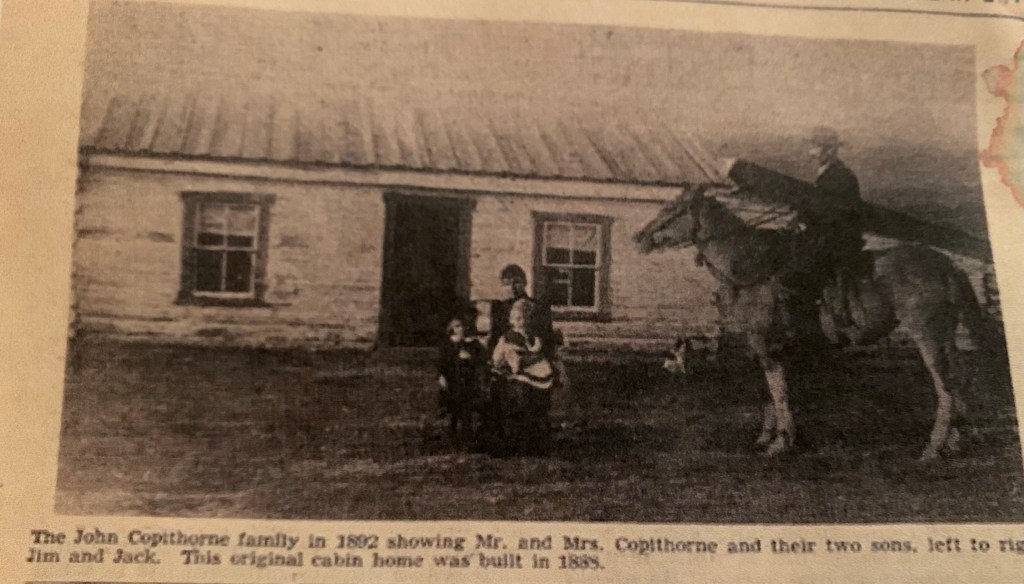
Jack Copithorne of Calgary has a fine photograph taken when he was a very young chap. It shows his mother, his brother, and himself, just outside their home, the white-washed log shack, and looking with pride on the small group as the father seated on his buckskin pony.

Jack and Mrs. J.C. Buckley, daughter of Richard Copithorne, recall how they and other children in the district rode their ponies to school, a pleasure which the child of today rarely knows. The old school still stands one and a half miles west of the Jumping Pound Post Office, and like other buildings, is made of logs. It was constructed by John Stewart and was considered very attractive with its red roof, whitewashed walls, and green trim.

Some of the teachers whose names will be remembered are Miss M.A. Walsh, Robinson, Hart, and Kent.

Church services were held in the school, and before it was built, in the various homes in the district. The minister had a large territory to cover but was always a welcome visitor.

Everyone took a great interest in politics and there was always lively discussion as to the merits of various candidates for office.

There are always amusing incidents to recall. There was the time when one of the Copithornes saw a bundle up in a tree and took a shot at it. Out fell and Indian corpse, not in good condition. Then, another time the cowboy with his chaps and guns was all for going out to find and capture, by force if necessary, the lost souls mentioned by an enthusiastic Salvation Army worker.

John Copithorne retired in 1912 and moved to Victoria. He died in 1933 and surviving are his widow, six sons: Jim of Sidney, BC; Jack, Calgary and Jumping Pound; Harry, Jumping Pound; Claude of Cochrane; Ernest, Calgary; Charles, Midnapore; and two daughters: Mrs. L.D. Nicoll, Jumping Pound, and Mrs. M. Morris, Victoria. One son, Bert, Died some years ago.

Richard’s four sons are: Percy, now at the home place, and George who farms eight miles west; Frank, now on the old Fraser River ranch, and Clarence, on Clemen’s ranch; his two daughters: Mrs. J.C. Buckley (Marjorie), Springbank, and Mrs. Annie Jones of Okotoks. Richard died in 1936.

Sam Copithorne’s two sons are Louis and Bill, and his two daughters are Mrs. J.E. Robinson, and Mrs. Rex Young.

Sam is too busy these days with spring work to be bothered talking about his family, and anyway he doesn’t think it is important. But stories of Canada’s pioneers should not be lost, and who of these old-timers ever kept a diary? Their sons and daughters have heard their tales many a time, but they too, forget and much of Canada’s fascinating and unique history remains unknown.

The debt that this generation and posterity owes to the men and women who opened up this country, can never be repaid. Not only were there great material advantages, but if we can emulate their integrity, their great independence of mind and body and spirit, then indeed we may prove worthy of the hardships which they undertook so courageously and as a matter of plain fact.
Standard
happiness

A Brief History of the Copithorne Family 2 (FGK 152)

“John told about the Indian Sun-Dance. It was about the time of the Frog Lake Massacre and the Indians were pretty touchy. He had given out rations of print etc to be made into clothing. Instead they tore it up into little pieces and stuck it on the tree tops long before the Sun Dance. He described the Sun Dance much as you read about it today but the braves cut holes in their shoulders, put thongs through the muscles, and dragged poles, and sometimes ponies around and around the lodge, always yelling at the top of their voices, until they would faint.

“Well he got a job with the Indian department as farm instructor at Crooked Lakes near Qu’Appelle, Saskatchewan and then he followed the railway to Sarcee. You remember they were issuing rations to the Indians in 1886 and 1887 and that’s what John was doing and running freight from Sarcee to the Stones. He used to drive a bull team; took him two days to make the journey.

“He had to stay overnight at the home of Napoleon Blanche; that was the only house between the two reserves. Nearly always John had an Indian guide.

“There is a story that Mr. Blanche trie to raise hogs just like cattle. He would turn the sows out on the range in the spring. It would be nothing to jump a bunch of razor-back hogs during the summer as one rode across the country. In the fall the hogs, as many as could be found, were gathered in. The next problem was the slaughter and dressing of these porkers. Apparently Mr. Blanche was not very skillful at the job for when scalding and shaving off their hair failed he decided to skin them. After all were skinned they looked such a gory and disturbing sight that he decided to put them up in the hay loft. He stood the frozen carcasses on their feet and covered them with hay so that nobody could see them. However, a neighbour made a friendly call one evening and went to the loft to get feed for his horse. Uncovering one of the skinned hogs gave him such a start that he backed up and fell down through the hole in the floor to the manger below. He wasn’t injured but certainly had a good fright.

“It was a mighty different life to what my folks had planned for him. He’d taken the civil service examinations in Ireland and he’d passed. But he just wouldn’t take a job. That’s what my father wanted for me too, but I wanted to go farming. I was going to go to Australia, but I came out to my brothers’s place instead.

“Anyway, Dick was the next one to come to Canada. He got here in 1887 and first of all he got a job in Calgary working on the old Mission Bridge so that he’d have enough money to buy a team and wagon.

“Then they started looking for land; the country wasn’t surveyed then, and they passed through Springbank to Jumping Pound. So John and Richard were in partnership from 1888 go around 1900.

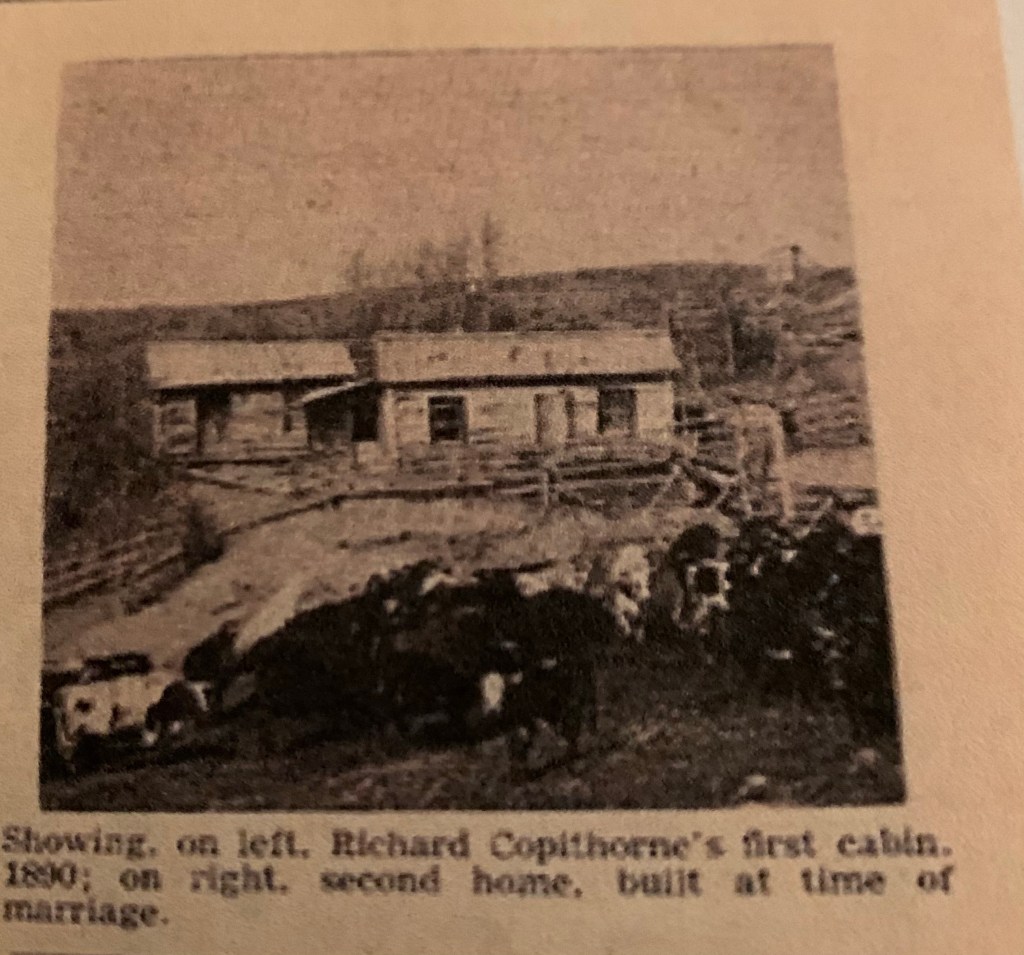
‘If a man had an axe and a hammer and a saw, he could build anything. So John and Dick built a log house with a sod roof, and stables, also of logs and with a sod roof.

“The house had just one room, one window and the door was right in the centre of the front wall. The second house Richard built was nearby; it had two windows and a lean-to for a kitchen. That was on the hill. John built his house at the foot of the hill on the river bank. He got married in 1887 to Susan Toone. She was jut out from Ireland. She’s 86 now and living in Victoria BC.

Standard
happiness

A Brief Story of the Copithorne Family 1 (FGK 151)

I found this interview with Sam Copithorne and thought it could be fun to share. At the end of the stories, I’ll post the information to source it, but this is written by Dora Dibney – I have no idea who she was. I always wondered (but not badly enough to ever ask lol) who Grandpa was named after – and it looks like it was after one of his uncles. Enjoy!

A Brief Story of the Copithorne Family

(Dora Dibney)

“Now look,” Sam Copithorne remarked, “there’s no use writing a story about me. I’m not a pioneer becuase I didn’t come out to this country until 1904. It’s my two brothers you ought to write about, if you HAVE to write about the family.”

“Where was I born? Oh, in Clonakilty, that’s in County Cork, Ireland. My father had a dairy farm, dual purpose Short horns and we milked about 25 cows. Guess we had about 120 acres.

“Besides John and Richard, I had four older brothers: James and William and Robert and Edward. We had one sister: she was the eldest. John came out here in 1883 and Richard came out four years later in 1887.

“James went to Central Africa as a missionary and before that he was in the civil service. but he was in Africa, oh less than a couple of years when he got fever and died.

“John was the first to make a move though. He just decided to come to Canada so my father got him a lot of letters of introduction to people in Montreal, but he never used a single letter.

“He didn’t like Montreal so he bought a ticket through to Winnipeg. Well he looked for work and somehow or other he met a man who wanted someone to drive eight mules. John had never had a thing to do with mules, but he waits sure he could drive them so he got a job and $10 a month. That was doing farm work.

“It wasn’t long after that that a man came to the farm and he bought the mules. He couldn’t drive them so John got the job of taking them to Brandon.

“That was the time of the rebellion I, so John volunteered for the army and he was sent to live with the Indians and watch their movements. Well, he lived with them for a long time; he took part in their powwows and he got so he could talk Cree with the best of them.

“He lived with them so long that they nearly forgot he wasn’t an Indian. They used to call him Wapoorshwian which means Rabbit-Skin-Robe. I remember him telling us about the way they used to eat. They’d put all their meat into one big pot and they’d sit around and fish it out when it was cooked. Sometimes they’d fish out a piece of dog meat and then they’d remember and say “white man no eat dog” so they’d find a piece of rabbit meat for him.

Standard
happiness

All the best in 1956 (FGK-62)

Grandma had her new kitchen by now! In all of the old photos I’ve seen of this house, I’ve never seen the lean to kitchen that was there before this big, beautiful kitchen was built. The story I was told was that there was a step down from the main house into the kitchen, and one time mom was walking on her crutches and fell down the stair into the kitchen. That was it, and Grandma insisted there be a proper kitchen built without any steps for mom. And what a kitchen she built! It still is my favourite room in the whole world (and where I sit while I write this).

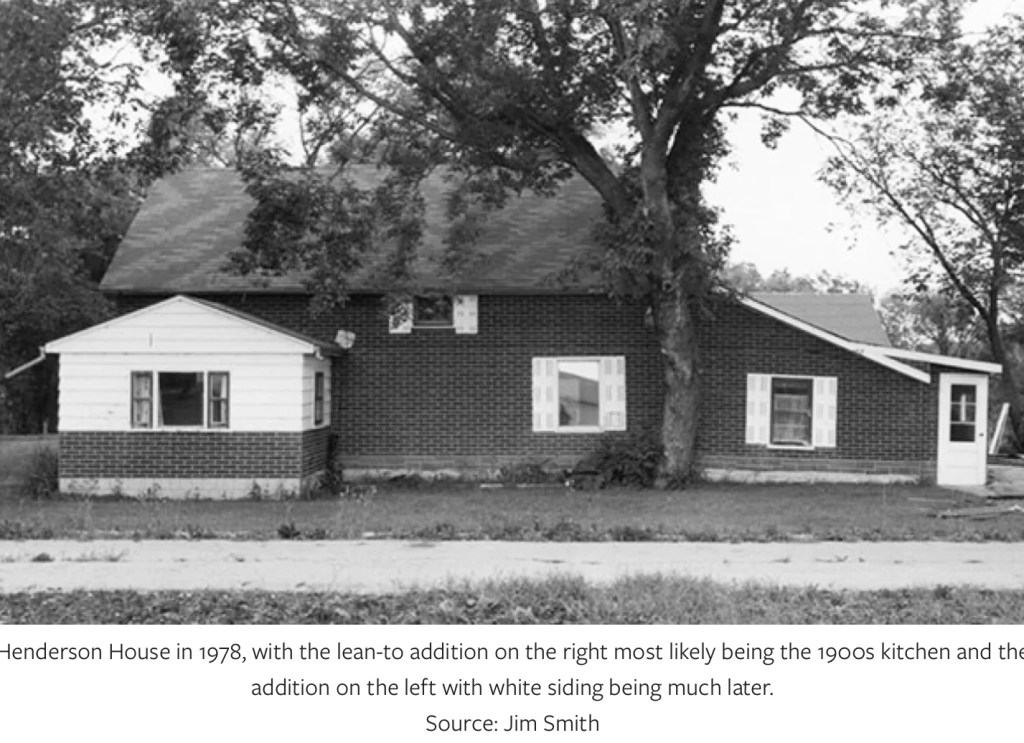
Here’s an old photo I found in some archives of a house in Manitoba with a lean to kitchen. I’m assuming the old one here was something like this, but again I’m not sure as I’ve never seen photos. And every time I ever asked either Grandma or Mom about the old kitchen my questions were never answered, instead they told me how wonderful the new one is (and it really, really is). Even in this kitchen the amount of cooking Grandma had to do is staggering, I don’t know how she managed in a smaller and more rustic space.

RR3 Innisfail, Alta

February 9, 1956

Dear Margie

I was so glad to get your letter and to know that your operation did some good and that you are able to be up and around. You will be anxious to get home again.

We heard you over the radio at Xmas and were so glad to hear you. We did enjoy the programme.

Had a nice long letter from your Mum a while ago and did enjoy it. Would love to drop in on her sometime. She seems to be enjoying the new kitchen. I’m sure it will be lovely.

We are really enjoying our lovely mild weather. Surely hope it doesn’t turn to cold again. It is nice to be looking forward to spring.

Take care of yourself and all the best in 1956

Love

Aunt Jean

Standard