happiness

Edna’s Story 17 (FGK 134)

I read these stories and I have to ask – If the generations before us knew what little asshats Shetland ponies were, whey did they make us ride them??? Aren’t we supposed to be making life easier for the generations that follow us??? I suppose it must have been an early method of toughening us up haha. Here’s A link to a write up about that war prison camp Grandma mentions.

One fall a cattle buyer who bought our steers, gave Marshall a Shetland pony when he was about four years old. I have never liked Shetland ponies but Marshall was very happy and wanted to be on it all the time. One fine afternoon when I decided to ride across the creek and get the milk cows in, I let Marshall ride his pony and come with me. My horse stopped half way across the creek to have a drink and I looked back to see how Marshall was doing. Clarence was building a fence nearby. The Shetland had stopped at the edge of a deep pool to have a drink too, and I could see both Marshall and the saddle were slowly sliding over his head. I called to Clarence just about the time Marshall plopped into the cold water. The dumb Shetland sat on the bank like a dog sits down and it had the saddle on its head like a hat. Clarence and I both headed to the rescue but things happened too fast for us. Marshall no sooner hit the water when he bounced out again and was in a howling rage. It all looked so comical. Clarence and I just went into helpless laughter which only made Marshall furious. He walked home in a huff and we were so weak from laughing at that crazy looking pony we could hardly get the saddle off. Later that pony ran away with Sheila one day and threw her onto a big rock and broke her elbow.
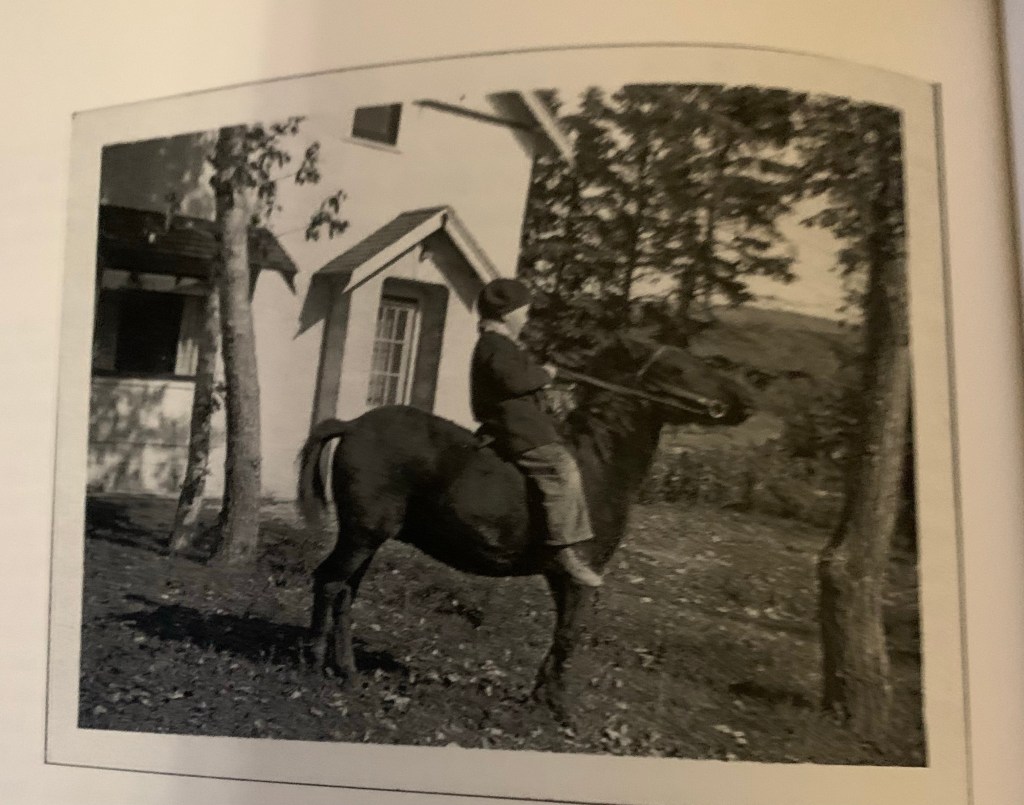
My father had sold his farm and rented an apartment in Calgary. While Sheila was in the hospital with her broken arm – it had to be broken a second time to get it right – my Dad visited her every day and read stories to her. He also helped Percy cut crop a few times when help was scarce. He loved the children dearly and always called Margi “Peggie”. The last day he visited us in November 1942, Marshall and Margi clung to his legs and begged him to stay but he had two companions with him and returned to town. That night he died of a heart attack.

As the war advanced, our lack of manpower became a real problem. The French Canadians came to work in the harvest fields but were unused to our ways. One year we had a harvest crew of soldiers and they were very good. The Indians helped us a lot as long as the work wasn’t too steady, and we always liked working with them. During the war there was a war prison camp up at Kananaskis and every now and then one or two would escape and we were about the closest area of civilization. We were nervous but usually the persons were quite thankful to be captured again after a night or two in this rugged country.
Standard
happiness

Edna‘s Story 16 (FGK 133)

I’m starting to understand why when we were young, my cousin and I didn’t get into more trouble the time we were camping and accidentally sunk the Suburban into the creek. Not to say we were praised for it, and she may have been in more trouble than I was, but I remember being terrified of how my uncle would respond when we came walking all the way home from the campsite the next morning. He just went and got the tractor and pulled the vehicle out. Then we all agreed to never mention it again – except here I am mentioning it. 38 years later (you can do the math to figure out how old we were at the time) it’s still kinda funny.

On Friday afternoons I used to ride over and teach a short Sunday School class. Central United Church gave us some of their old hymn books and Marge led the singing.

I gave Sheila and Marshall each a nice sleigh for Christmas and strange to say we didn’t have enough snow for the next two years to get sledding.

Clemons Hill School often heard small social gatherings for entertainment. I remember one box social our young people went there and we had a lot of laughs over the almost innocent mix up in the identity of the boxes. The first admirers bid up hard earned money then got the wrong box. Sometimes our young folks would get together and drive in their jalopies to the dances at Bragg Creek. They had to drive through the river to get there and one night one car stalled in midstream. The boys gallantly carried the girls ashore but complained bitterly about the hefty ones. We would hear all about those events the next night at supper time, and that way shared in their entertainment.

One night when they were going to a show in Calgary they had a flat tire and no jack. They tossed a coin to see who would go to a nearby farmhouse to borrow one. The boy who had to go was not in a very pleasant mood to begin with but he came running back with a big dog after him and the whole seat of his pants torn out. The others in the car laughed so hearty it didn’t improve his mood for a week or more. Another time one of the boys who owned an old Model-T Ford coup was driving to a dance in Cochrane one dark night and one of Edge’s black bulls was sleeping on the road. Bill couldn’t see it and hit its rear end just as it was getting up. It put his radiator just about in his lap. Bill had such a humorous way of talking he kept us all in laughter listening to his escapades. He went all through the Blitz and Holland invasions getting into scrapes like that and is still talking about them. There was such a gang working here and at the neighbours all the time, but made much of their own fun.

Standard
happiness

Edna’s Story 15 (FGK 132)

When I was a kid and completely obsessed with horses and fully awkward around people (things haven’t changed much), I used to be so envious that mom, my aunt, and uncle got to ride to school. It didn’t really occur to me that they were riding in -20C or how difficult and scary it would have been to cross the creek in flood. No wonder Grandma was so terrified of the creek. Still though….

It wasn’t long before we were issued a ration book for each one of us. Transient help would come to work with all the tabs sold out of their books and we would just have to cope with it somehow, but they weren’t very popular.

In February 1940 I left Sheila and Marshall with my sister and Percy and I took Aunt Ada and her bachelor brother Ray Wills on a motor trip to visit Aunt Lil in Palemeno, California. We thoroughly enjoyed it, especially the wonderful Redwood Forest, and visiting the old fort where the Russians had landed in 1812, the fort still standing in good condition because Redwood won’t burn or nor decay.

Before I left I taught Clarence how to make apple pie. When we got home the man who helped him batch said they just made steak out of the whole half beef and had apple pie nearly every meal. And his pies were just about the best I’ve ever tasted, much better than mine, but I doubt if he has ever cooked one since, they were certainly glad to quit cooking.

By now we had a delco in the house – no more coal oil lamps and those frightening Coleman gas lamps. at first we had a gas engine to charge the sixteen two-volt batteries. Then we got a wind charger, which worked fine when the wind blew. We were so glad to have just the lights, we never thought of complaining because there were no electric gadgets to be got on the 32 volts.

Margaret, my last child, was born in October 1940. We let Sheila name her, she was so thrilled to have a baby sister, so she said “I like Margaret Bateman, let’s call her Margaret”. She was a dear little baby, had long dark hair when she was born and always very lively. I lay in the hospital listening to the Battle of Britain on the radio and wondering if I was right to bring a child into such a world. The way they were bombing London that week, I felt we didn’t have a chance. We used to entertain a few Airforce boys who were stationed in Calgary training. They were a long way from home and sure appreciated a few home cooked meals. The training planes became quite a problem flying over our house, just about touching the top of our trees. They would wake up baby Margi and she’d howl in terror. It made me realize how terrifying it must have been for the people in Britain who had the real thing zooming above them.

Sheila started school in 1941 to Clemon’s Hill School. It was a long, difficult, and lonely ride for a small child. We were fortunate to find an older girl who didn’t live near a school and came and lived with us and rode to school with Sheila. Sheila rode my horse Spades. I’ll always remember one spring morning when the Jumping Pound was in flood. It was a raging torrent so Percy rode across and led Dora’s horse with her on it then came back for Sheila. They were getting along fairly well until a tree came rushing down in the current and frightened Spades. He pulled loose from Percy and headed back for home. Old Robert and I were standing on the bank ready to catch Spades, but he missed the crossing and just plunged up and down in the swift, deep water. Sheila clung to his back like a little spider. The poor horse tried his best to get out but the banks was too steep there. However, he stretched his head out and Robert was able to grab his bridle and pull him upstream to the crossing. Sheila was soaked so I let Dora go to school alone that day. I was so thrilled to have child in school and see her take part in her first Christmas concert, Marge Van Der Velde was the teacher, and just a lovely teacher.

Standard
happiness

Edna’s story 14 (FGK 131)

Our water here still comes up from the well by the creek to the old house (Annie’s house mentioned here) and then across to Grandma’s house (where I am), then over to the cottage. It also is the water source for the barn and for my cousin’s place.

Chapter 3

The War Years

We finally dug a ditch to Annie’s house and go the water in 1938. Just a cold tap in the kitchen and a slop bucket beside the sink for a year or so. Then we dug a septic tank east of the house and put in bathroom fixtures and hot and cold water. That lightened the workload but we were still very, very crowded, especially at meal times. Finally the men had time to dismantle an old house in the area and built a lean-to over the kitchen door where we put a big table and used it as a dining room, down three steps from the kitchen. About then we got a battery-set radio. It was wonderful to get the world news every day, but becoming very disturbing to hear it. Then one day in the fall of 1939, the news that we were all dreading to hear came over the air. We were at war! It really shook us more than we ever expected it to. The happy carefree talk at mealtime was changed a lot. The whole outlook of our operation as a ranch was changed. Two of the men joined up and went overseas. From then on we just hired older men and the Indians helped us when we needed extras. The government urged us to raise hogs and grow as much food as we possibly could. I began to buy my chicks and turkey poults from the hatchery and raised larger flocks of poultry. Before this we had so few eggs all winter I always put the summer surplus eggs in water glass to preserve them for use all winter. A rare treat was to have fresh eggs for breakfast Christmas morning.

Percy decided to go into hogs properly. He built a prescribed round brooding house with a stone in the centre and separate pens out from it. It really was a neat setup; it housed ten brood sows. We had a little mill run by the old John Deere tractor with lugs on it, Model D, and chopped our own grain. Those pigs were an awful amount of work; extra chores before and after the day’s work. The men fenced an area down to the creek for them to range on but every now and then they would get out. I remember a couple of younger boys on the crew just couldn’t sleep in the bunkhouse because the two older ones snored so loud. They said one snored so loud they raised the roof and then the other one let down again. So these boys took their blankets and slept out on the hillside on a fine night. Once they were awakened by a big old sow rooting against them. The snorers sure kidded them after that.

When the ten sows were furrowing someone had to be on the job day and night. One young sow went mad and tried to destroy all her little family. She was frothing at the mouth and tossing the poor little creatures in all directions when Percy went in. He picked up three that were still alive and brought them into the house to see what I could do for them. Two just lay still and groaned but one had a large triangular rip in its side and almost two feet of entrails hanging out. It was squealing quite lively. I got a needle and thread and wound the intestines around my fingers and carefully tucked them in and swerved it up and fed it warm milk. I kept it in a box in the kitchen for a few days, the other two died. Finally it got too lively so we gave it to a gentle sow who could handle one more. That little pig grew up and raised two families of her own before we sold her, but she always had a funny hollow in one side.

Standard
happiness

Edna’s Story 13 (FGK 130)

I don’t remember Grandpa’s legendary sneezes, but Mom used to tell stories about how epic they were. It has become a family competition with me and the kids to see who can best carry on that tradition and I’m pretty sure some of our sneezes shake the very foundation of the house.

Percy always sneezes terribly loud, you can almost hear him a mile away. He often came to the end of his patience trying to teach the junior rake boy how and where to drive his rake. One day when the boy was in the wrong place away across the field, Percy called him into the stack and gave him a good lecture and sent him off to where he was supposed to be. He just got there when Percy sneezed. The poor kid came galloping back to the stack thinking he had been called in for another lecture. The men often laughed over that, tired and all as they were when they got in at night, they had many laughs over the supper table.

In the evenings, Percy repaired all the breakdowns and the mower men sharpened their knives either evenings or before breakfast. Our crew hauled the XC hay valley too. That wild prairie grass was very nutritious, we were always able to winter our cattle on it without any supplements. We could even winter our calves on it without feeding them any grain.

Standard
happiness

Edna’s Story 12 (FGK 129)

I remember how fantastic Grandma’s garden was, and I’ve heard stories about the garden at the old house. Even when we moved in there 6 years ago there were still a few old perennials that were growing – old reminders from the days of Richard and Sophia. There also is still one lonely asparagus plant at the very edge of the old garden that often makes an appearance -this one solo plant has been there for as long as I can remember.

Spring finally came and we had the big garden to plant that Percy’s Dad always grew so well. I shouldn’t say “we”. Percy has always looked after the vegetable garden just like his Dad did, only he never had time to try any unusual plants in it until lately. I remember his Dad growing asparagus and raspberries, and he even tried celery once. He was a wonderful Gardner and taught me such a lot. Percy and I have always had pleasure in our flower garden, but it was never so extensive as the one his Dad grew. Gardening began in April when he built the hotbed. Only a big load of fresh manure would be used, as other manure doesn’t heat enough. The frame, a bottomless wooden box about six feet by four feet was placed on the pile of manure that was piled beside the garden in a sunny, sheltered spot. The box was filled with good garden soil. Old storm windows were used for a lid and this covered with old horse blankets, binder canvas, or any discarded robe until the weather got warm enough to put a roll of white cotton over it. In this we started all our cabbage and cauliflower, snapdragons, stocks, petunias, marigolds, and anything else that needed to be planted early – before April 15th.

After the garden was planted, and the crops too, then we got ready for haying. But first came the branding in June. There was a lot of riding and sorting cattle before the big day. The neighbours all helped each other brand. We would take tea and lunch out to the men in the morning, then hurry in to prepare a big, hot meal for about 25 or 30 and sometimes 40 sat down to that meal. But they would have the job done by noon. One man was kept busy stoking the fire and handing hot irons to the men. One branding man would look after four flappers or men who wrestled the calves down. And two or three men did the cutting, which included ear marking, castrating, and cutting off horns. Another man vaccinated for blackleg. It always has been a gory business, but the men seem to enjoy working together like that. And there were always some faithful lady friends who came to help me with the meal too. Our little group of about eight ranches around here who work together must brand many thousand head of calves every hear and very efficiently.

The haying is a big job all summer long. I’ve always regretted I didn’t have time to get out with the camera some morning and take a picture of the men and horses as they left for the hay field. The valley east of our house is a lovely long valley which was an ideal natural hay field. Our two neighbour’s outfits and our outfit would all be going over the hill to the field about the same time each morning. There were 32 head of horses in these outfits, all tied together, some to the horse’s tail in front. The men change horses at noon, that is why they had to have so many in the morning. Most of the horses were four year old broncos that had just been broken to harness in June. The stores of the hair-raising experiences with those wild horses in the hayfield would fill a book. A hearty breakfast of porridge, meat and eggs, huge plates of toast and homemade jam was ready at seven am. By then the men had their horses in the corral, and we would have the lunch box almost ready for the field. Their lunch consisted of six or eight big loves of homemade bread with a variety of fillings, two pies, and cake. This was enough for their morning lunch and a noon meal and afternoon lunch. They drank cold tea. We have nine men in the field, three mowers, three rakes, two men on the stack, and one in the sweep. Percy stacked hay all through the summer – a heavy, hot job.

Standard
happiness

Edna’s Story 11 (FGK 128)

I remember Grandma being paranoid about the creek. My earliest childhood memories include lectures about staying away from the creek and how children would die, DIE, if they went down there alone. Of course this meant that I spent countless hours down at the creek by myself as a kid poking through things and throwing rocks into the water. In fact, we came back to visit the summer my daughter was nine and I’d left her with my mom while I was off doing something else. Both mom and I had thoroughly lectured her about the dangers of the creek (and it was in flood when we were there), but genetics can be something powerful. Mom hadn’t even noticed the girl was missing before the neighbour (the same one who used to pull me out of the creek when I was down there doing stupid things) arrived with my girl and said “I found her staring at the creek. This HAS to be Melissa’s girl”. And the obsession with the creek has continued.

As I said before, money was scarce and there was no hope of making our tiny kitchen larger. I loved my little kitchen when there were only the three of us, but that winter trying to crowd four and sometimes six more people around our little table and then squeeze between it and the stove was just impossible. I must admit we were a jolly crew and had many hearty laughs and jokes about it all. That winter was a long one. Marshall was born in March and about that time, Percy brought his cows home from Olds. He bought some of their hay they had for sale and when he got it home the cattle wouldn’t eat it. It was slough hay they had cut on top of the ice and it didn’t even make good bedding. When driving them home from the stockyards in Cochrane, one old cow just played out about four miles south of Cochrane, so he had to leave her there as it was getting late. Next morning she was standing at the gate at the home corral.

Fortunately Marshall was a healthy, happy baby because I was too busy to fuss much. I remember very foolishly ironing diapers for Sheila and everything had to be just so, but not so with Marshall. We baked eight or 10 loaves of bread every other day – set it to rise overnight. I used those hard Royal yeast cakes. I even made my own soap for a while. There was so much fat after butchering and I had a good soap recipe. Poor Sheila must have been a bit neglected then too because once when she was only two years old she was playing around the yard while I was churning in the basement. She tried to look through the window and both she and the window crashed to the cement floor. It was a long fall. Fortunately, she was not cut by glass but did bite her tongue and lip badly.

Shortly after that, Mr. Coppock Sr persuaded Percy to take trainloads of cattle with him to Minneapolis thinking prices were better there. I was washing clothes and Sheila was out in the yard pulling a little toy in the snow. Marshall was sleeping in his buggy. When I went to check on Sheila she was gone. I searched frantically everywhere, even went down to the creek and looked for her tracks around the water holes in the ice. Finally I roused the neighbours and four or five men went out on horseback looking for her. Jack Copithorne found her. There was a heavy bush in the filed northeast of the hall at that time and he found the little pull toy on the road by the hall. Then he heard the little spaniel dog barking to answer his call and the dog stayed with Sheila leading him to the centre of the bush were she was. I nearly collapsed.

Standard
happiness

Edna’s Story 10 (FGK 127)

There were three or four steady men to cook for and do their laundry. I was kept quite busy. The men milked about a dozen cows and separated the cream. We had to walk over to the dairy every morning (located near Annie’s house) to wash the pails and separator rain or shine. One bowl had 35 disks which had to be washed and rinsed separately. I churned once or twice a week and with the butter and eggs bought the groceries. Butter requires a lot of cold, cold water to wash all the buttermilk out of the butter to make it firm. Then you add salt and work it in, then pat it into a mold so that the result weighs exactly one pound. My churn was a big wooden barrel one that made about thirty pounds at a churning. We carried the water from a well on the other side of Annie’s house. It seemed like a quarter of a mile away.

We had a big windlass built out in the corral and butchered our beef there. Hung it up on the windlass to clean and skin, about an hour’s work. Then after it hung in a cool place for ten days, we would cut it up and put it into a brine and some jars and cook it. I also canned chicken. I remember one time I starved the roosters and other chickens to be butchered as usual the night before so they would have empty crops and be easier to handle. Never thinking about the weed seeds in the bottom of the trough. The chickens ate them. I had forty beautiful jellied jars of chicken but when I opened them to use they smelled so strong of stink weed and tasted like it too. I nearly wept when I couldn’t use them.

The year of 1936 was the driest one anyone could remember in our district. There was practically no crop to harvest nor hay to cut. Percy was very worried about feed for the cattle, and he had the enormous tasks of settling affairs of the estate as well. The dirty 30s seemed to be extra dirty to us when we lost our beloved parents but all over Canada people were suffering poverty and drought, so many, so much worse than we were. The men left the cattle out on the range waiting for the first fall of snow because there was so little feed at home. Cattle from the district have used the range at the base of Jumping Pound Mountain and Moose Mountain since long before it was made into a forest reserve. Riders camped up there to round up the cattle and bring them home early in November if not sooner.

This year, late in the evening of November 18th 1936, Jack Copithorne came up to visit Percy and to point out a pin point of smoke southwest on the range. They became very worried and decided to leave for the round-up camp, “The Lone Star” about 4am the next morning. I remember setting bread and baking it that night, along with fries and other food to send up with the wagon later in the morning but the wagon never left home. The men left on horseback and when they got as far as Frank Sibbald’s they met the fire and it swept past them. Here at home we had a high wind and the air was so full of smoke and dust you couldn’t see anywhere. Percy went into Sibbald’s and phoned home to tell me to send a man and a tractor up to Sibbald’s. He ploughed quite a furrow down north of Sibblad’s house to save it if the wind changed. But there was just no way of stopping that fire.

I was expecting my second child then, not quite as active and spry as I’d like to have been, but able to do the work just the same. When word came over the phone to vacate our homes and go to the creek for safety from the fire, I decided to put Sheila in the car and try to drive to safety. The story of my being trapped in the fire is told elsewhere in the history of our district. When I got home from the episode, I had a good two inches of solid cinders in my hair which took several shampoos to remove. The fire never reached our house and so I had done the wrong thing and got severely told about it even though it was not all entirely my own idea of what was best to do. When Percy came riding home he had lost our precious collie dog somewhere in his mad travels trying to save livestock. We wondered if we would ever see him again and loved him almost like a person. The next day, half of Calgary drove out to view the devastation and most of Cochrane too. All of the burnt country looked the same, just miles and miles of black cinders – no fences – no telephone poles, and nothing alive. Percy’s cousin Claude drove over to the Brushy Ridge area and while driving about three miles north of us, he saw something move. He got out and called to it and it nearly knocked him down racing to him and piled into the car. Claude continued his tour and then came to see ow we were doing and you can imagine our joy when “Buster” got out of his car. We often wonder if Buster recognized a Copithorne about Claude, or if there was something familiar about his voice. There were literally thousands of people milling around there and Buster was a very shy dog.

The following week, the ranchers started out to locate feed for their cattle. Percy’s brother George had just bought a new car and he offered to drive Percy, Frank, and Clem Gardner up into the Olds country to buy some straw stacks. They got a few miles north of Calgary when the car hit some loose gravel and rolled over into the ditch. It rolled over about four times before it came to a stop against a telephone pole, and it was upside down. No one was hurt at all, but they said everything was all mixed up like a pup’s breakfast inside that car. Later in the week they got to Olds and arranged to ship their cattle and put them out in little herds on the many farms that had straw stacks. Some of our men spent the winter up there looking after the cattle. What a winter that was! I think Percy became very well acquainted with the farmers around Olds and the snow was so deep up there that it was piled 10 feet high on the side roads.

Standard
happiness

Edna’s Story 9 (FGK 126)

What a year my grandparents’ first year of parenting must have been. The excitement of a girl, both Grandma and Grandpa losing a parent, Auntie Sheila getting so sick, Uncle Frank being in the hospital for the winter. It’s a lot. I think I wrote this before, but when my son was born I was determined that he was going to eat healthy, which meant no sugar for at least the first year of his life (first child – I gave up when the girl was born). Dad very defiantly sat at the Christmas dinner table in the dining room here in Grandma’s house and shoved Grandma’s pudding sauce into his pie hole. And when your first taste of sugar is Grandma’s sauce it’s setting the bar pretty darn high for dessert expectation. Perhaps that’s why he became a chef.

In 1929 Jack Copithorne and Dave Lawson combined their teams of horses and pulled Archie Ceris’s homestead house down to a spot between Nicoll’s and and Jack’s to be used for a school house. All the children in the district were living in this neighbourhood at that time. The fall after we were married, in 1932, the teacher Marg Ervin boarded with us and walked to this school. Marg was a city girl and found it very lonely at our place. She was extremely musical and we brought my mother’s piano out for her to play on. We enjoyed many musical evenings after that. Frank, Percy’s brother, got married to Georgie McDougal in 1934 and lived on the XC ranch. That year Gertrude Flumerfelt came to teach and boarded with us until our Sheila was born in 1935. While Gertrude was here, my mother’s health deteriorated and she spent considerable time with us too.

Sheila was a real pride and joy to everyone. The first baby girl to be born in the district for 15 years and everyone made a great fuss over her and she was a darling! Percy’s dad used to hold her on his knee and give her little bits of food at mealtime. She sure started eating ice cream at an early age. By now my mother’s health was so poor my Dad rented a house in Cochrane and moved her in near the doctor. He was fortunate to get Mrs. E.C. Johnson, her dear friend, to come and live with her and nurse her that year. She died when Sheila was only six months old. When I was in Cochrane so much, Sheila came in close contact with my sister’s daughter, Aileen, who was, unknown to us, just coming down with the whooping cough. Sheila caught the whooping cough and what a winter we had after that. Frank was in the hospital all winter and poor Georgie was alone with Richard who was only a tiny baby then. Sheila’s health was poor after that until she was two years old when we had to have her tonsils out.

Percy’s father died in April 1936, when Sheila was just a year old. It threw the whole responsibility of the ranch and family on Percy and Frank’s shoulders. Clarence was only 14 years old. He seemed so young to lose his father after having lost his mother when only two years old. Annie carried on as usual that summer, cooking etc for the haying crew, for which I was very thankful. But it was as short haying season and by then when I took on the job of feeding the men, the poultry, and dairy, I was expecting my second child. But I at least got a washing machine of my own and certainly needed it with all of the men’s clothes to wash as well as my own. Sometimes there were as many as fifteen shirts to iron each week. This washing machine was run by a gas engine – a very temperamental one. I often gave up trying to get it started then in temper would give it a swift kick and it would start. Annie decided to take a business course in Calgary and do secretarial work in there. She continued to keep the big house as her country residence and as we were in a very small house, Clarence slept over there but otherwise lived with us. Space had to be found in our tiny home for the girl who had been helping Annie, as she agreed to come and work for me. She must have missed the convenience of the big house, with its electrify and running water. Also, it was a long walk from here to the chicken house and turkey pens.

To raise poultry we set the hens, both chicken and turkey. My they were temperamental when hatching. And brave. They would fly right at you if they thought you would hurt their eggs. A few days before the eggs were to hatch I would place each egg in a dish of lukewarm water and if they bounced around I knew they had a strong chick inside. If an egg just floats lifelessly it is infertile and I’d throw it out. Sometimes a loud clap of thunder would coddle all the eggs. I’m sure the concussion caused when our super sonic planes break the sound barrier now must kill the life in many bird’s eggs. The warm water bath also helped to soften the shell for the chicks to break into our big harsh world. I waked miles along the hillsides to the creek looking for turkey eggs. The turkeys hid their nests and covered the eggs with leaves as soon as they were laid. They started laying in February and if the eggs ever got chilled they never would hatch.

Standard
happiness

Edna’s Story 8 (FGK 125)

Percy owned a very nice 28 Chevy and his father drove a Chandler. A very precious Chandler. I think Percy is the only other person that ever drove the Chandler, and then it would be because of a dire emergency. Living beside Annie and her father was a great advantage for me in many ways. Percy was terribly busy all the time but his Dad would drive to Calgary or Cochrane, and occasionally would take me with him. And driving with him was an experience I will never forget. He was a good horseman but I doubt if he ever felt at ease with a car. After we would get into the car and were all settled and ready to drive off, he would race the engine so that I was sure something would explode any minute. And sure enough, we did! We shot forward with such a leap I don’t know why we didn’t all have whiplash! Then we would level off and enjoy the scenery. At least father Copithorne did enjoy it and as he turned this way and that way to look, the car turned too! When we got to Calgary the streetcars just were supposed to get the h….. out of his way, why not? Coming home from Calgary alone one day he drove over two little calves near Springbank. Then just didn’t get out of his way. I was horrified when I heard it and asked if he had killed them. He just laughed and said he had to get out and pull them out from under the car, but when he threw them in the ditch they ran away. Then he said “It wouldn’t matter anyway, they were only Holsteins.” In his way of thinking, Herefords were the only kind worth raising. Another time he missed a turn in the road and had to get an axe to chop this way out of the bushes and back on the road.

Shortly before we were married, Percy gave me a fine big black saddle horse named “Spades”. He was part Arabian and very gentle. I loved going out riding with the gang when they were working the cattle. Annie rode a very beautiful spirited hob hunter and she certainly was a good rider. Percy’s dad always had a string of coyote hounds following him and occasionally they would go after a poor little rabbit that crossed our path.

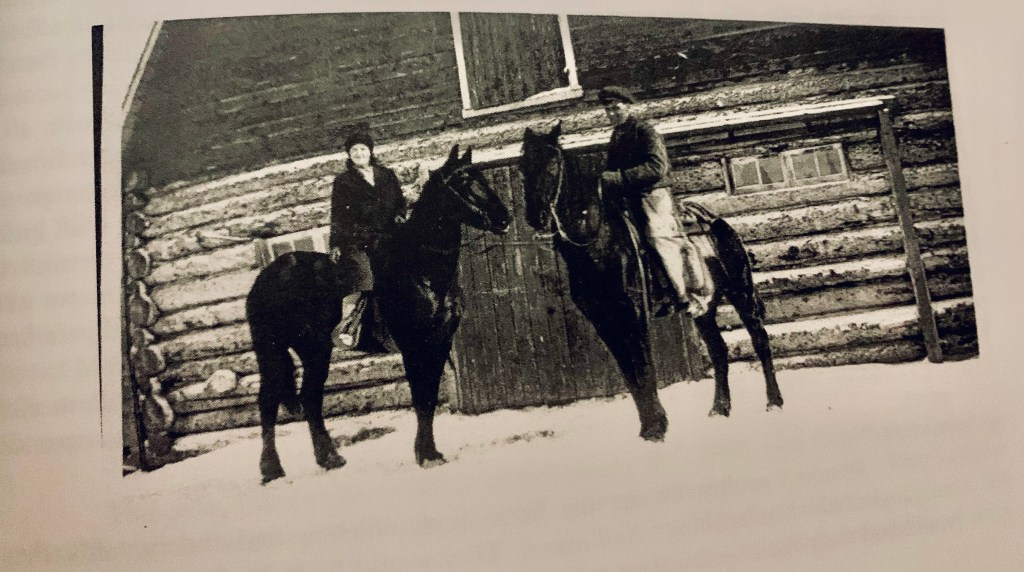
Grandma and Grandpa in front of the barn Grandpa built – it’s still in use today and over 100 years old.

Standard