I don’t remember Grandpa’s legendary sneezes, but Mom used to tell stories about how epic they were. It has become a family competition with me and the kids to see who can best carry on that tradition and I’m pretty sure some of our sneezes shake the very foundation of the house.
Percy always sneezes terribly loud, you can almost hear him a mile away. He often came to the end of his patience trying to teach the junior rake boy how and where to drive his rake. One day when the boy was in the wrong place away across the field, Percy called him into the stack and gave him a good lecture and sent him off to where he was supposed to be. He just got there when Percy sneezed. The poor kid came galloping back to the stack thinking he had been called in for another lecture. The men often laughed over that, tired and all as they were when they got in at night, they had many laughs over the supper table.
In the evenings, Percy repaired all the breakdowns and the mower men sharpened their knives either evenings or before breakfast. Our crew hauled the XC hay valley too. That wild prairie grass was very nutritious, we were always able to winter our cattle on it without any supplements. We could even winter our calves on it without feeding them any grain.
I remember how fantastic Grandma’s garden was, and I’ve heard stories about the garden at the old house. Even when we moved in there 6 years ago there were still a few old perennials that were growing – old reminders from the days of Richard and Sophia. There also is still one lonely asparagus plant at the very edge of the old garden that often makes an appearance -this one solo plant has been there for as long as I can remember.
Spring finally came and we had the big garden to plant that Percy’s Dad always grew so well. I shouldn’t say “we”. Percy has always looked after the vegetable garden just like his Dad did, only he never had time to try any unusual plants in it until lately. I remember his Dad growing asparagus and raspberries, and he even tried celery once. He was a wonderful Gardner and taught me such a lot. Percy and I have always had pleasure in our flower garden, but it was never so extensive as the one his Dad grew. Gardening began in April when he built the hotbed. Only a big load of fresh manure would be used, as other manure doesn’t heat enough. The frame, a bottomless wooden box about six feet by four feet was placed on the pile of manure that was piled beside the garden in a sunny, sheltered spot. The box was filled with good garden soil. Old storm windows were used for a lid and this covered with old horse blankets, binder canvas, or any discarded robe until the weather got warm enough to put a roll of white cotton over it. In this we started all our cabbage and cauliflower, snapdragons, stocks, petunias, marigolds, and anything else that needed to be planted early – before April 15th.
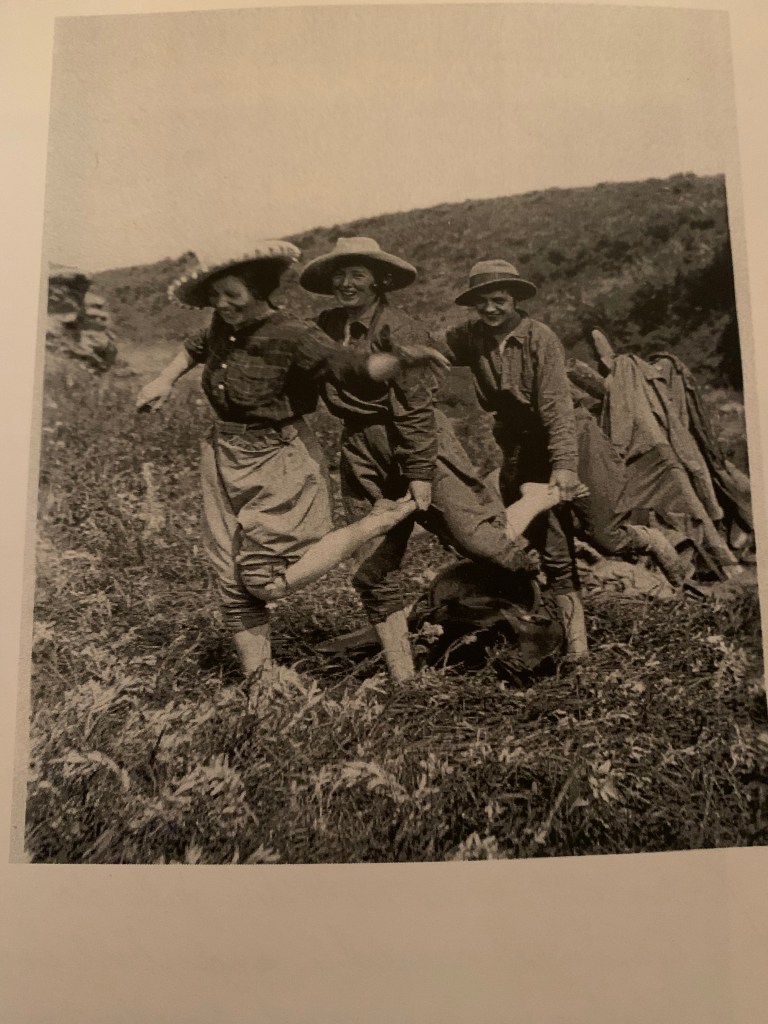
After the garden was planted, and the crops too, then we got ready for haying. But first came the branding in June. There was a lot of riding and sorting cattle before the big day. The neighbours all helped each other brand. We would take tea and lunch out to the men in the morning, then hurry in to prepare a big, hot meal for about 25 or 30 and sometimes 40 sat down to that meal. But they would have the job done by noon. One man was kept busy stoking the fire and handing hot irons to the men. One branding man would look after four flappers or men who wrestled the calves down. And two or three men did the cutting, which included ear marking, castrating, and cutting off horns. Another man vaccinated for blackleg. It always has been a gory business, but the men seem to enjoy working together like that. And there were always some faithful lady friends who came to help me with the meal too. Our little group of about eight ranches around here who work together must brand many thousand head of calves every hear and very efficiently.
The haying is a big job all summer long. I’ve always regretted I didn’t have time to get out with the camera some morning and take a picture of the men and horses as they left for the hay field. The valley east of our house is a lovely long valley which was an ideal natural hay field. Our two neighbour’s outfits and our outfit would all be going over the hill to the field about the same time each morning. There were 32 head of horses in these outfits, all tied together, some to the horse’s tail in front. The men change horses at noon, that is why they had to have so many in the morning. Most of the horses were four year old broncos that had just been broken to harness in June. The stores of the hair-raising experiences with those wild horses in the hayfield would fill a book. A hearty breakfast of porridge, meat and eggs, huge plates of toast and homemade jam was ready at seven am. By then the men had their horses in the corral, and we would have the lunch box almost ready for the field. Their lunch consisted of six or eight big loves of homemade bread with a variety of fillings, two pies, and cake. This was enough for their morning lunch and a noon meal and afternoon lunch. They drank cold tea. We have nine men in the field, three mowers, three rakes, two men on the stack, and one in the sweep. Percy stacked hay all through the summer – a heavy, hot job.
I remember Grandma being paranoid about the creek. My earliest childhood memories include lectures about staying away from the creek and how children would die, DIE, if they went down there alone. Of course this meant that I spent countless hours down at the creek by myself as a kid poking through things and throwing rocks into the water. In fact, we came back to visit the summer my daughter was nine and I’d left her with my mom while I was off doing something else. Both mom and I had thoroughly lectured her about the dangers of the creek (and it was in flood when we were there), but genetics can be something powerful. Mom hadn’t even noticed the girl was missing before the neighbour (the same one who used to pull me out of the creek when I was down there doing stupid things) arrived with my girl and said “I found her staring at the creek. This HAS to be Melissa’s girl”. And the obsession with the creek has continued.
As I said before, money was scarce and there was no hope of making our tiny kitchen larger. I loved my little kitchen when there were only the three of us, but that winter trying to crowd four and sometimes six more people around our little table and then squeeze between it and the stove was just impossible. I must admit we were a jolly crew and had many hearty laughs and jokes about it all. That winter was a long one. Marshall was born in March and about that time, Percy brought his cows home from Olds. He bought some of their hay they had for sale and when he got it home the cattle wouldn’t eat it. It was slough hay they had cut on top of the ice and it didn’t even make good bedding. When driving them home from the stockyards in Cochrane, one old cow just played out about four miles south of Cochrane, so he had to leave her there as it was getting late. Next morning she was standing at the gate at the home corral.
Fortunately Marshall was a healthy, happy baby because I was too busy to fuss much. I remember very foolishly ironing diapers for Sheila and everything had to be just so, but not so with Marshall. We baked eight or 10 loaves of bread every other day – set it to rise overnight. I used those hard Royal yeast cakes. I even made my own soap for a while. There was so much fat after butchering and I had a good soap recipe. Poor Sheila must have been a bit neglected then too because once when she was only two years old she was playing around the yard while I was churning in the basement. She tried to look through the window and both she and the window crashed to the cement floor. It was a long fall. Fortunately, she was not cut by glass but did bite her tongue and lip badly.
Shortly after that, Mr. Coppock Sr persuaded Percy to take trainloads of cattle with him to Minneapolis thinking prices were better there. I was washing clothes and Sheila was out in the yard pulling a little toy in the snow. Marshall was sleeping in his buggy. When I went to check on Sheila she was gone. I searched frantically everywhere, even went down to the creek and looked for her tracks around the water holes in the ice. Finally I roused the neighbours and four or five men went out on horseback looking for her. Jack Copithorne found her. There was a heavy bush in the filed northeast of the hall at that time and he found the little pull toy on the road by the hall. Then he heard the little spaniel dog barking to answer his call and the dog stayed with Sheila leading him to the centre of the bush were she was. I nearly collapsed.
There were three or four steady men to cook for and do their laundry. I was kept quite busy. The men milked about a dozen cows and separated the cream. We had to walk over to the dairy every morning (located near Annie’s house) to wash the pails and separator rain or shine. One bowl had 35 disks which had to be washed and rinsed separately. I churned once or twice a week and with the butter and eggs bought the groceries. Butter requires a lot of cold, cold water to wash all the buttermilk out of the butter to make it firm. Then you add salt and work it in, then pat it into a mold so that the result weighs exactly one pound. My churn was a big wooden barrel one that made about thirty pounds at a churning. We carried the water from a well on the other side of Annie’s house. It seemed like a quarter of a mile away.
We had a big windlass built out in the corral and butchered our beef there. Hung it up on the windlass to clean and skin, about an hour’s work. Then after it hung in a cool place for ten days, we would cut it up and put it into a brine and some jars and cook it. I also canned chicken. I remember one time I starved the roosters and other chickens to be butchered as usual the night before so they would have empty crops and be easier to handle. Never thinking about the weed seeds in the bottom of the trough. The chickens ate them. I had forty beautiful jellied jars of chicken but when I opened them to use they smelled so strong of stink weed and tasted like it too. I nearly wept when I couldn’t use them.
The year of 1936 was the driest one anyone could remember in our district. There was practically no crop to harvest nor hay to cut. Percy was very worried about feed for the cattle, and he had the enormous tasks of settling affairs of the estate as well. The dirty 30s seemed to be extra dirty to us when we lost our beloved parents but all over Canada people were suffering poverty and drought, so many, so much worse than we were. The men left the cattle out on the range waiting for the first fall of snow because there was so little feed at home. Cattle from the district have used the range at the base of Jumping Pound Mountain and Moose Mountain since long before it was made into a forest reserve. Riders camped up there to round up the cattle and bring them home early in November if not sooner.
This year, late in the evening of November 18th 1936, Jack Copithorne came up to visit Percy and to point out a pin point of smoke southwest on the range. They became very worried and decided to leave for the round-up camp, “The Lone Star” about 4am the next morning. I remember setting bread and baking it that night, along with fries and other food to send up with the wagon later in the morning but the wagon never left home. The men left on horseback and when they got as far as Frank Sibbald’s they met the fire and it swept past them. Here at home we had a high wind and the air was so full of smoke and dust you couldn’t see anywhere. Percy went into Sibbald’s and phoned home to tell me to send a man and a tractor up to Sibbald’s. He ploughed quite a furrow down north of Sibblad’s house to save it if the wind changed. But there was just no way of stopping that fire.
I was expecting my second child then, not quite as active and spry as I’d like to have been, but able to do the work just the same. When word came over the phone to vacate our homes and go to the creek for safety from the fire, I decided to put Sheila in the car and try to drive to safety. The story of my being trapped in the fire is told elsewhere in the history of our district. When I got home from the episode, I had a good two inches of solid cinders in my hair which took several shampoos to remove. The fire never reached our house and so I had done the wrong thing and got severely told about it even though it was not all entirely my own idea of what was best to do. When Percy came riding home he had lost our precious collie dog somewhere in his mad travels trying to save livestock. We wondered if we would ever see him again and loved him almost like a person. The next day, half of Calgary drove out to view the devastation and most of Cochrane too. All of the burnt country looked the same, just miles and miles of black cinders – no fences – no telephone poles, and nothing alive. Percy’s cousin Claude drove over to the Brushy Ridge area and while driving about three miles north of us, he saw something move. He got out and called to it and it nearly knocked him down racing to him and piled into the car. Claude continued his tour and then came to see ow we were doing and you can imagine our joy when “Buster” got out of his car. We often wonder if Buster recognized a Copithorne about Claude, or if there was something familiar about his voice. There were literally thousands of people milling around there and Buster was a very shy dog.
The following week, the ranchers started out to locate feed for their cattle. Percy’s brother George had just bought a new car and he offered to drive Percy, Frank, and Clem Gardner up into the Olds country to buy some straw stacks. They got a few miles north of Calgary when the car hit some loose gravel and rolled over into the ditch. It rolled over about four times before it came to a stop against a telephone pole, and it was upside down. No one was hurt at all, but they said everything was all mixed up like a pup’s breakfast inside that car. Later in the week they got to Olds and arranged to ship their cattle and put them out in little herds on the many farms that had straw stacks. Some of our men spent the winter up there looking after the cattle. What a winter that was! I think Percy became very well acquainted with the farmers around Olds and the snow was so deep up there that it was piled 10 feet high on the side roads.
What a year my grandparents’ first year of parenting must have been. The excitement of a girl, both Grandma and Grandpa losing a parent, Auntie Sheila getting so sick, Uncle Frank being in the hospital for the winter. It’s a lot. I think I wrote this before, but when my son was born I was determined that he was going to eat healthy, which meant no sugar for at least the first year of his life (first child – I gave up when the girl was born). Dad very defiantly sat at the Christmas dinner table in the dining room here in Grandma’s house and shoved Grandma’s pudding sauce into his pie hole. And when your first taste of sugar is Grandma’s sauce it’s setting the bar pretty darn high for dessert expectation. Perhaps that’s why he became a chef.
In 1929 Jack Copithorne and Dave Lawson combined their teams of horses and pulled Archie Ceris’s homestead house down to a spot between Nicoll’s and and Jack’s to be used for a school house. All the children in the district were living in this neighbourhood at that time. The fall after we were married, in 1932, the teacher Marg Ervin boarded with us and walked to this school. Marg was a city girl and found it very lonely at our place. She was extremely musical and we brought my mother’s piano out for her to play on. We enjoyed many musical evenings after that. Frank, Percy’s brother, got married to Georgie McDougal in 1934 and lived on the XC ranch. That year Gertrude Flumerfelt came to teach and boarded with us until our Sheila was born in 1935. While Gertrude was here, my mother’s health deteriorated and she spent considerable time with us too.
Sheila was a real pride and joy to everyone. The first baby girl to be born in the district for 15 years and everyone made a great fuss over her and she was a darling! Percy’s dad used to hold her on his knee and give her little bits of food at mealtime. She sure started eating ice cream at an early age. By now my mother’s health was so poor my Dad rented a house in Cochrane and moved her in near the doctor. He was fortunate to get Mrs. E.C. Johnson, her dear friend, to come and live with her and nurse her that year. She died when Sheila was only six months old. When I was in Cochrane so much, Sheila came in close contact with my sister’s daughter, Aileen, who was, unknown to us, just coming down with the whooping cough. Sheila caught the whooping cough and what a winter we had after that. Frank was in the hospital all winter and poor Georgie was alone with Richard who was only a tiny baby then. Sheila’s health was poor after that until she was two years old when we had to have her tonsils out.
Percy’s father died in April 1936, when Sheila was just a year old. It threw the whole responsibility of the ranch and family on Percy and Frank’s shoulders. Clarence was only 14 years old. He seemed so young to lose his father after having lost his mother when only two years old. Annie carried on as usual that summer, cooking etc for the haying crew, for which I was very thankful. But it was as short haying season and by then when I took on the job of feeding the men, the poultry, and dairy, I was expecting my second child. But I at least got a washing machine of my own and certainly needed it with all of the men’s clothes to wash as well as my own. Sometimes there were as many as fifteen shirts to iron each week. This washing machine was run by a gas engine – a very temperamental one. I often gave up trying to get it started then in temper would give it a swift kick and it would start. Annie decided to take a business course in Calgary and do secretarial work in there. She continued to keep the big house as her country residence and as we were in a very small house, Clarence slept over there but otherwise lived with us. Space had to be found in our tiny home for the girl who had been helping Annie, as she agreed to come and work for me. She must have missed the convenience of the big house, with its electrify and running water. Also, it was a long walk from here to the chicken house and turkey pens.
To raise poultry we set the hens, both chicken and turkey. My they were temperamental when hatching. And brave. They would fly right at you if they thought you would hurt their eggs. A few days before the eggs were to hatch I would place each egg in a dish of lukewarm water and if they bounced around I knew they had a strong chick inside. If an egg just floats lifelessly it is infertile and I’d throw it out. Sometimes a loud clap of thunder would coddle all the eggs. I’m sure the concussion caused when our super sonic planes break the sound barrier now must kill the life in many bird’s eggs. The warm water bath also helped to soften the shell for the chicks to break into our big harsh world. I waked miles along the hillsides to the creek looking for turkey eggs. The turkeys hid their nests and covered the eggs with leaves as soon as they were laid. They started laying in February and if the eggs ever got chilled they never would hatch.
Percy owned a very nice 28 Chevy and his father drove a Chandler. A very precious Chandler. I think Percy is the only other person that ever drove the Chandler, and then it would be because of a dire emergency. Living beside Annie and her father was a great advantage for me in many ways. Percy was terribly busy all the time but his Dad would drive to Calgary or Cochrane, and occasionally would take me with him. And driving with him was an experience I will never forget. He was a good horseman but I doubt if he ever felt at ease with a car. After we would get into the car and were all settled and ready to drive off, he would race the engine so that I was sure something would explode any minute. And sure enough, we did! We shot forward with such a leap I don’t know why we didn’t all have whiplash! Then we would level off and enjoy the scenery. At least father Copithorne did enjoy it and as he turned this way and that way to look, the car turned too! When we got to Calgary the streetcars just were supposed to get the h….. out of his way, why not? Coming home from Calgary alone one day he drove over two little calves near Springbank. Then just didn’t get out of his way. I was horrified when I heard it and asked if he had killed them. He just laughed and said he had to get out and pull them out from under the car, but when he threw them in the ditch they ran away. Then he said “It wouldn’t matter anyway, they were only Holsteins.” In his way of thinking, Herefords were the only kind worth raising. Another time he missed a turn in the road and had to get an axe to chop this way out of the bushes and back on the road.
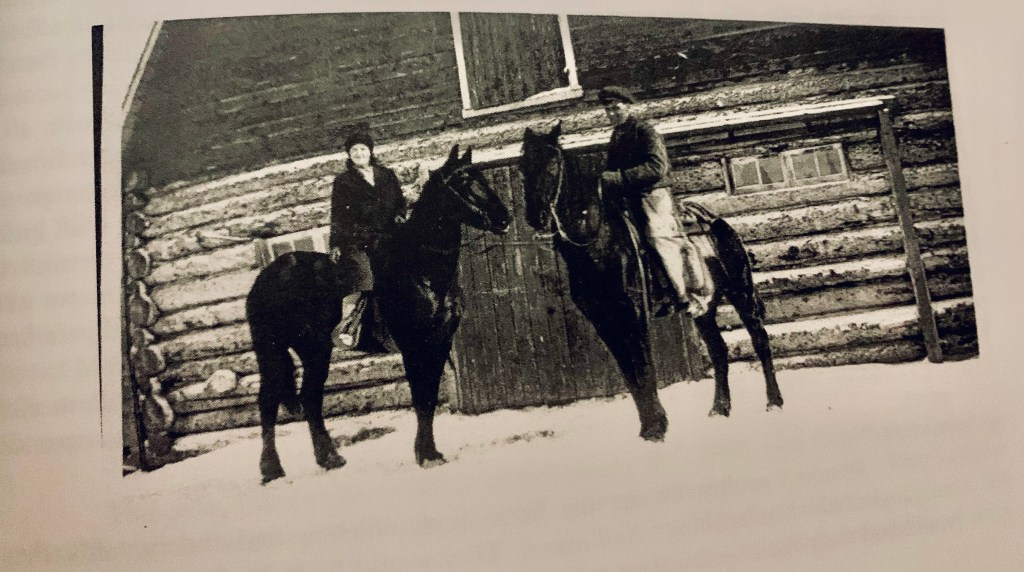
Shortly before we were married, Percy gave me a fine big black saddle horse named “Spades”. He was part Arabian and very gentle. I loved going out riding with the gang when they were working the cattle. Annie rode a very beautiful spirited hob hunter and she certainly was a good rider. Percy’s dad always had a string of coyote hounds following him and occasionally they would go after a poor little rabbit that crossed our path.
Grandma and Grandpa in front of the barn Grandpa built – it’s still in use today and over 100 years old.
I’ve said this before, but a day in the life of Grandma is exhausting for me to read. I can’t even keep up with my laundry now and I’ve got a fancy machine that does almost all of the work for me. I really need a machine that also folds and puts away.
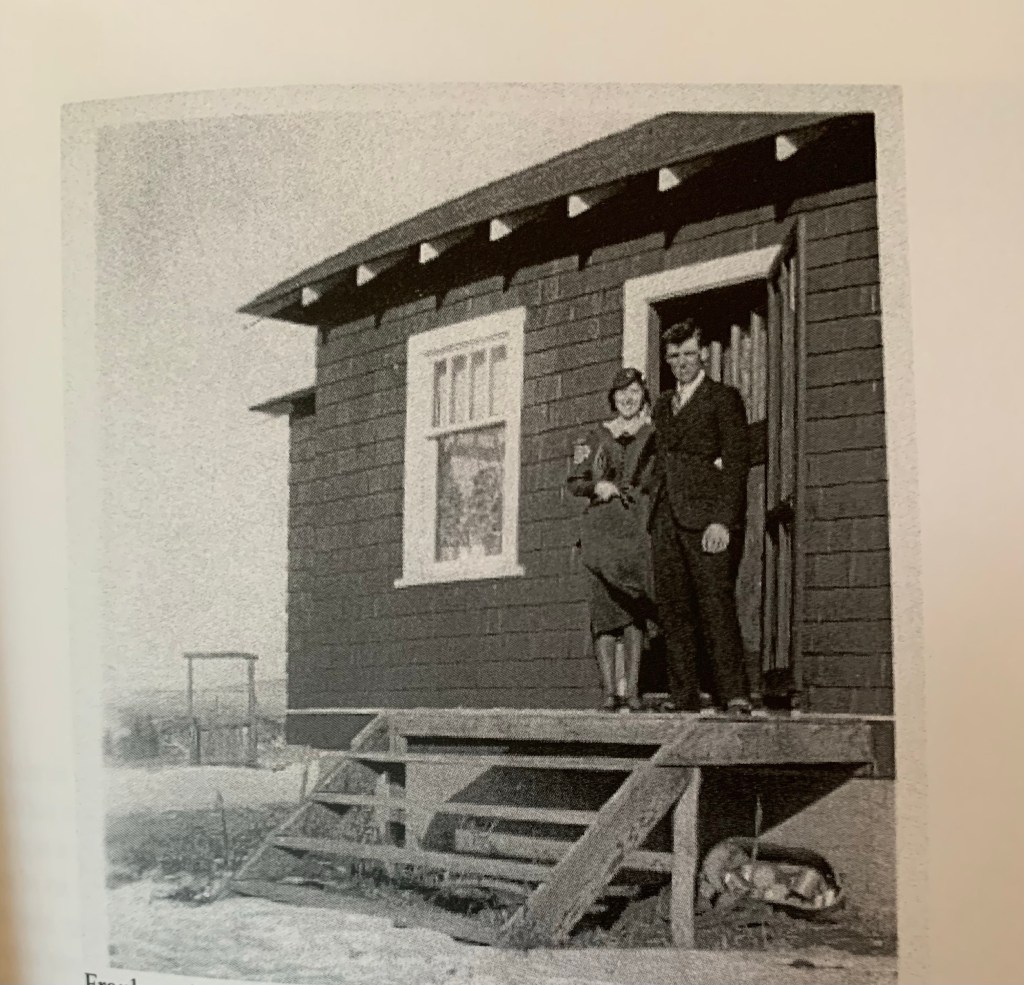
Well we aimed to spruce up that cottage cute too. It was all shingles outside and wallboard inside. I really don’t think any newlyweds should ever do their own decorating. We were so dumb and green about the job and chose the hardest wallpapers to match etc and just didn’t have a clue how to do it. Our ceilings were high and we thought it would look smart to have a drop ceiling. Percy brought in the sawhorses and put those planks on them. We tried to put the paper up to the ceiling across and down the drop on the other side of the room. What a schemoozle! There was always one end of that long slimy wet roll of ceiling paper dropping off just when you had the other end all neatly stuck on. Then when you ran to grab it the loose planks would upend and away went the paper hanger, or the glue, or both. It just wasn’t funny. Of course we were dumb enough to start in the living room and do all our practicing there. But when it was done it all looked lovely. Then Percy decided his job was outside staining the shingles. He made himself a scaffold to stand on and one nice day when I had the front door open and I was in the pantry peeling onions with tears rolling down my cheeks from that job, his scaffold broke and he took a nosedive right in the front door. He brought his pail of brown shingle stain in with him and splashed it all over one wall of the newly papered living room. I ran in to see if he was hurt and was so relieved to see he wasn’t but when he saw my tear-stained face he said “Good grief, you don’t need to cry about it.” I assured him I wasn’t crying. I was only peeling onions and he wasn’t so pleased about that either. Then we both saw the wall and I think we both felt like really crying.
Like Wordsworth’s description of Hiawatha’s friends “Straightway ran the path between them, never grew the grass upon it.” The path between me and Jack Copithorne’s and Nicoll’s was certainly well-worn. We used to meet at least once a week for tea, and always walked, as it didn’t seem far. Aunt Ada was an exceptionally fine cook. Her lemon jelly rolls and hot biscuits just make my mouth water to think about them. Nan Copithorne was always sewing and redecorating. I remember one time she decided to paint her long dining room in red and pink. We were all quite horrified, just couldn’t imagine anything pleasant about that combination. When she was finished she had us down for tea and were we ever surprised! It was beautiful. We learned that tones and shades make all the difference. Nan’s homemade bread was superb. For tea in June she would often serve strawberries, rich yellow cream, fresh bread, and fresh homemade butter. But the laughter and gaiety of those gatherings out-shone any food you could mention. Everyone had such a crew of young men working for them and every home had a girl to help too and they were all like one big happy family. They just made their own fun to compensate for the hard work.
I didn’t own a washing machine for five years after we were married. Those were the dirty 30s and money was scarce. My sister in law, Annie, had a five year old Maytag and allowed me to use it whenever I wanted to. The water here is the hardest in Alberta, a queer hardness, soap just went like chewing gum in it because of the rock formation peculiar to oil and gas fire lids. There were no water softeners dreamed of then. We would save every drop of rainwater and melt snow in the winter and sometimes haul water from the creek when all else failed. Laundry was a big job. Heavy loads of snow in boilers of water, all to be heated on the stove. I used to feel I was such a nuisance when Annie wanted her stove to cook on. And heavy loads of wet clothes to be carried home by hand and hung on the clothesline. We scrubbed and polished our bare floors. Polishing by hand is very hard work, but it certainly preserved the surface and in those days we preserved everything.
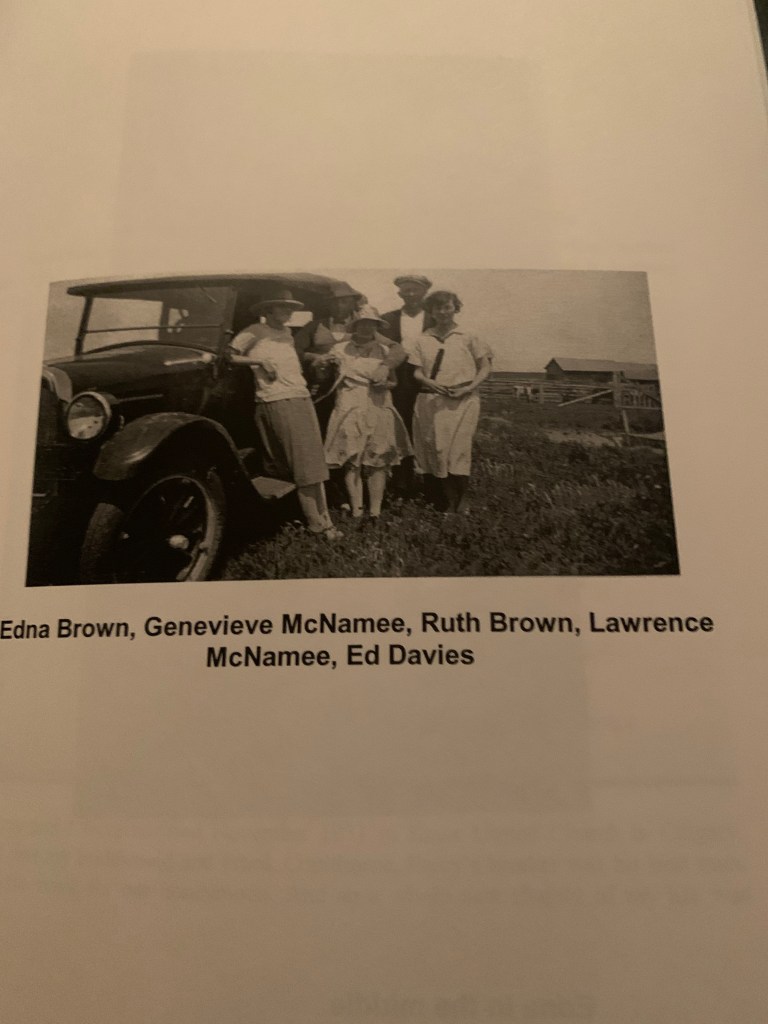
Ruth married Edgar Davies in 1927 and I rented a room from them while I worked for Mrs. Allan. Then Percy Copithorne asked me to go with him to a dance in upping PoundHall one day and we continued to go steady for over two years.
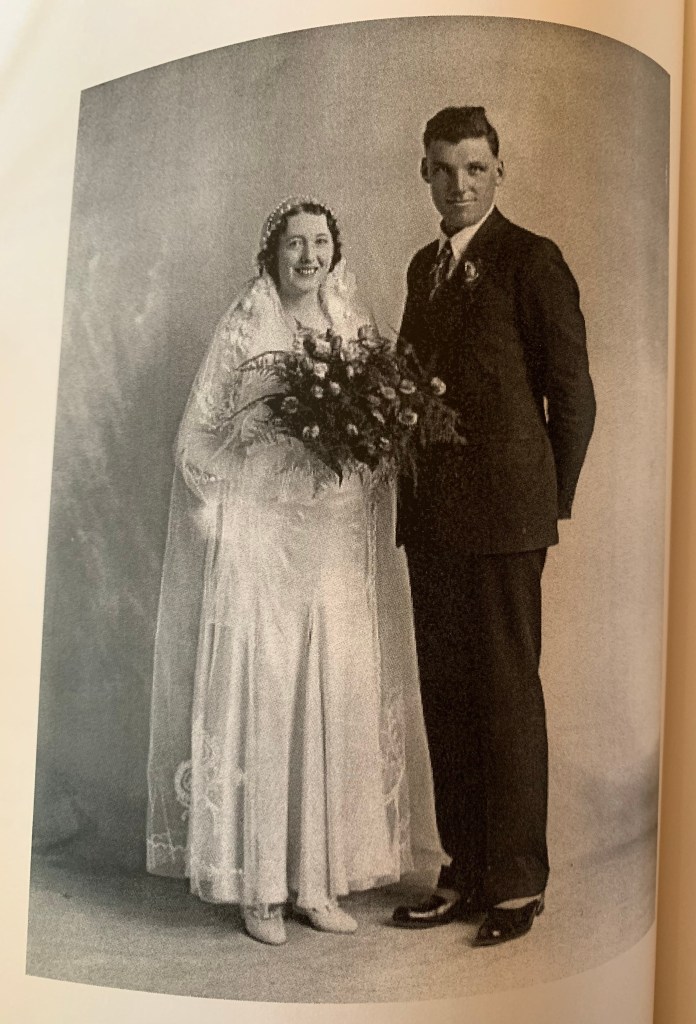
Percy and I were married in November 1931 in Know United Church in Calgary. Jean Russell was my bridesmaid and Frank Copithorne, Percy’s brother, was his best man. We went to the west coast for our honeymoon. And so a whole new chapter of my life was started.
Frank and Percy dug the basement of our cottage, then Mr. Frank Fletcher from Cochrane helped Percy build the cottage. We were fortunate to have natural gas in it right from the start. It was quite a change after my busy life in the store. The cottage seemed quiet and empty but I had wonderful neighbours who made up for that. First they schivereed us one evening. There must have been at least fifty people crowded into our small wooden house and they brought music and lunch and we danced until the small hours of the morning. Fortunately we hadn’t finished the floors or walls. There were heel marks halfway up the wall where they swung the ladies in the square dances. It was all great fun. Someone even kicked the middle leg off our new chesterfield but we put it back on and that chesterfield is still in constant use 44 years later. Then the community had a dance in the hall as they did in those days, honouring every bride and groom of the district. They presented us with a lovely silver carving set and cake server.
Percy was secretary for the hall for many, many years. Margie, his sister, got married later in the year to Jack C. Buckley of Springbank. I was immediately put on the sandwich making committee for the hall dances. We would order 12 or 14 sandwich loaves unsliced and slice them very thin. Two pounds of butter warmed to soft consistency to spread easy. Ham bought, then sliced very thin at the butcher shop and about four large tins of salmon mixed with a little home made salad dressing. The sandwiches were really good but the cakes everyone brought to the dances were just scrumptious. A favourite was one Nan Copithorne used to make – a big plain white cake with white icing covered with toasted almonds. Everyone seemed to be such good cooks, what a goal I had set to myself!
It wasn’t easy, but before long I had mastered a few good recipes too. It was so nice having Archie McLean taking full charge of the kitchen and making such delicious coffee in the two big copper boilers. He also cleaned the hall and all for only five dollars a night. Aunt Ada (Mrs. Jimmie Nicoll) always wore a million dollar smile and she had the art of meeting everyone at the dances and making them feel especially welcome. It was nice always having a floor manager – announcing each dance etc. They always had one moonlight waltz and when the evening was over they would dance to the song “Home Sweet Home” and everyone sang it. Usually the ladies wore long ball gowns even though it was the dirty 30s. Our hall was beautiful with dozens of Japanese lanterns and balloons hung from the ceiling. We had a pretty good local orchestra too, but Percy played the violin and that meant I had to sit out a lot of dances, likely I was clumsy and ugly too.
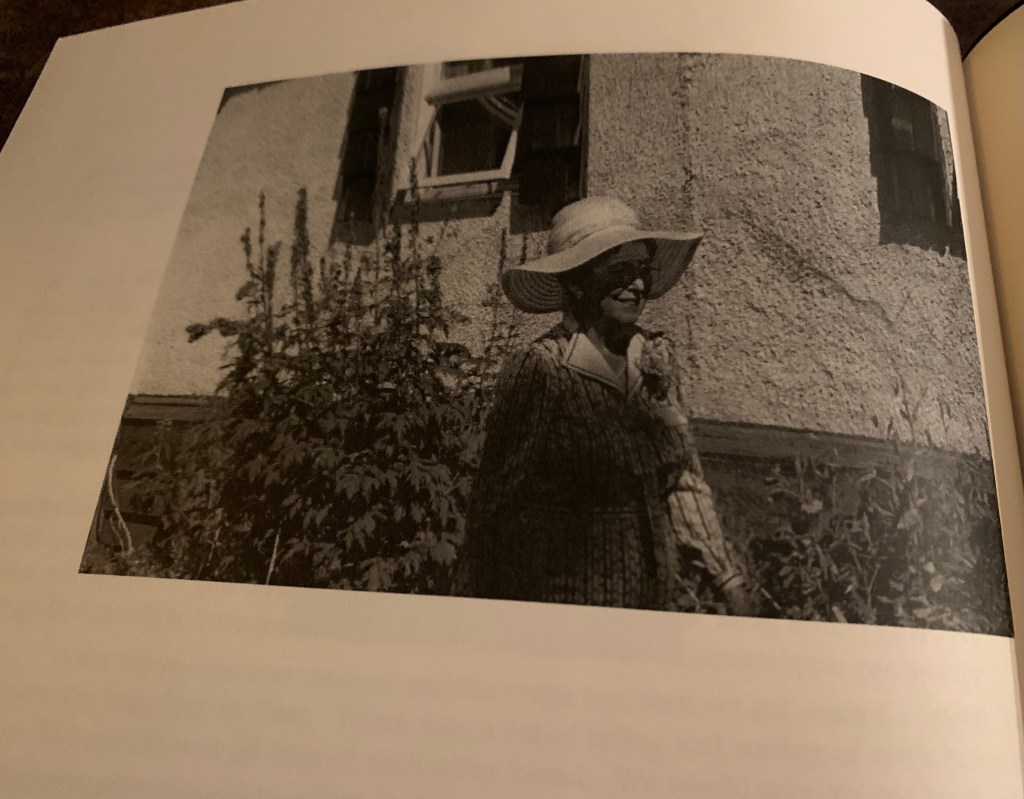
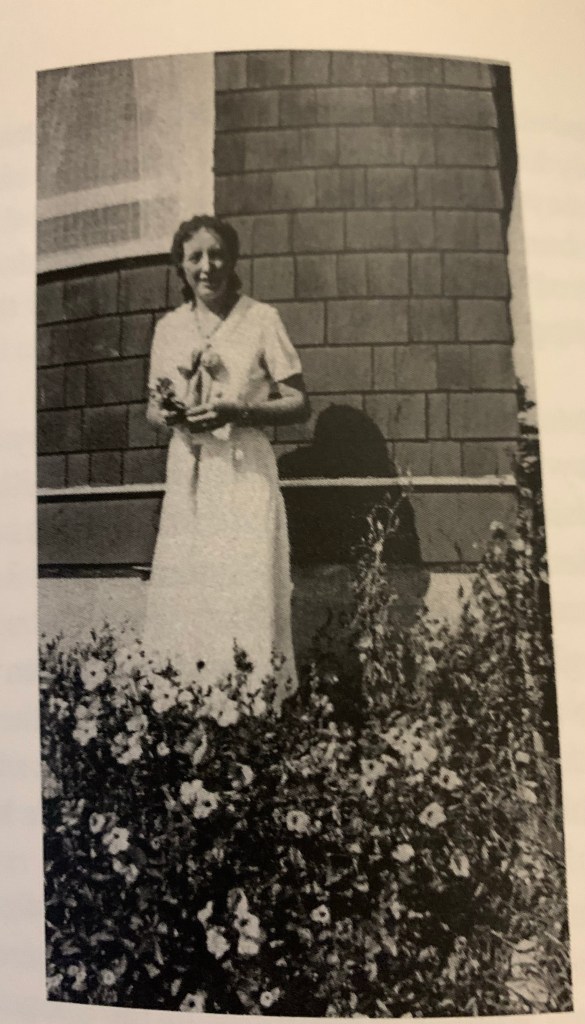
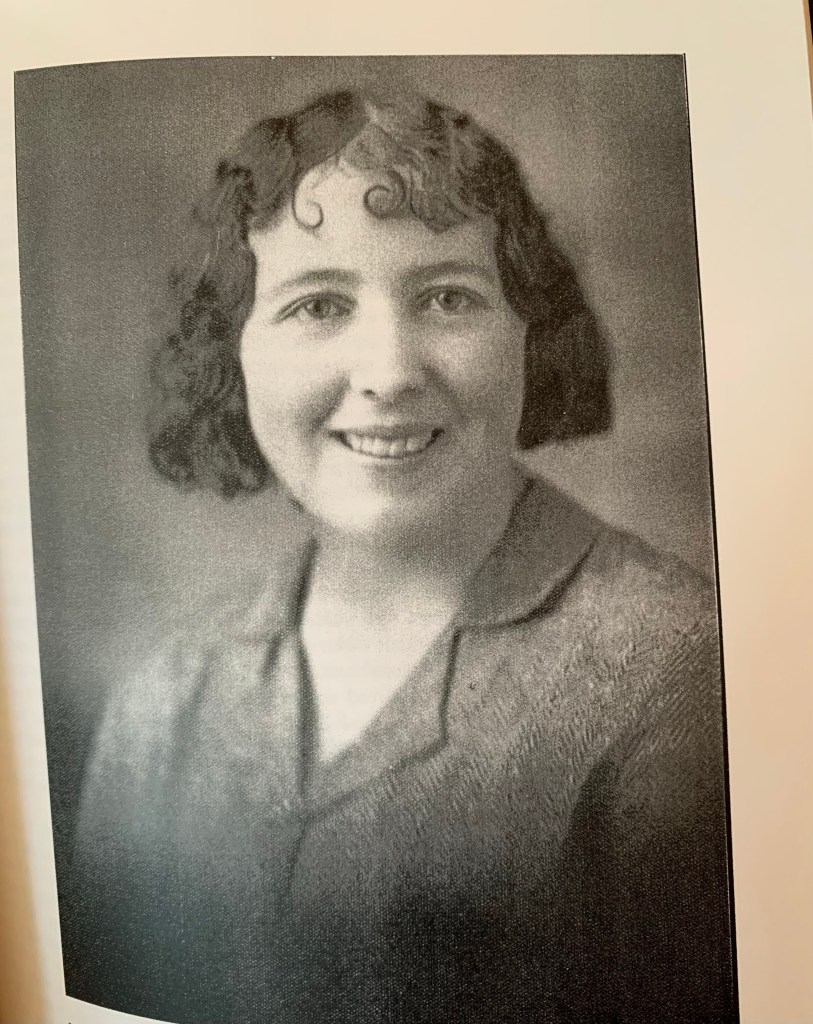
Not only was Grandma beautiful, but she taught me what it was like to be a lady who carried herself with dignity and grace.
One Saturday, George Camden decided to be generous and let his sister Elise and me go fishing with him. We walked the two miles down to Big Hill Creek and got quite bored standing there, quiet, watching George fish. Suddenly he caught one. Much to his surprise too, I think. He yanked it out and hit Elise across the face and she fell off the bank into the muskegie edge of the creek. She got all wet and muddy and so did I helping her and we got heck from George for being so noisy and clumsy, so we went home and left him there.
I sold Gold Cross garden seeds to the neighbours and got a beautiful violin from the company. The seeds were really good and grew well but I have my doubts about the violin. Anyway, I took lessons form Mrs. Easton in Cochrane and conned Ruth into playing those horrible scales on the piano so that I could follow in tune. I loved the violin and still do. Alex Beadle took violin lessons from Mrs. Easton too and once we had to play a duet at a concert in Cochrane. I shudder yet when I think of the awful squeaks I got out of that instrument. But the Chautauqua that used to come to Cochrane was wonderful. They really were an inspiration. Then came the radio. And Oh My! It was wonderful. We got Philip Aries to make us a crystal set and we would sit there just enthralled. And dare help anyone who walked across the floor and jiggled the needle off the crystal. I still think it’s magic that a thin delicate little thread of wire touching a piece of crystal rock could connect us to the world. Cochrane had an active minstrel show every winter for many years. We always looked forward to that. They used local talent and were popular in all the neighbouring towns too.
Once when I was riding home from school there must have been a wagonload of household furniture far ahead of me and they lost a stuffed bird off their load. I picked it up and took it home, it was quite nice. But later I got the bright idea of playing a joke on my Dad. So when he came home for supper, I put the bird up on a post and ran into the house all excited and showed him the bird. He got his gun out and sneaked around the corner of the house and shot it. His eyes sure popped out to see the stuffing all flying out and I sort of regretted losing the bird.
Riding to school all winter was quite a challenge. The horse would stand in the cold barn all day and could hardly wait for me to get on at night. By now I had two or three lively horses to ride. Sometimes it seemed we would hardly touch the ground, but just sailed out of town until we climbed the hill north of the creek. I often drove a cutter to school when the sleighing was good. A kind neighbour gave me a set of sleigh bells and the pony I drove tried her best to run away from those bells but the harder she raced the more music they made. It was exciting.
One very foggy morning while riding along the little path over the hills to school, I heard what seemed like a whole pack of coyotes howling quite close to me and he had his head thrown back and was halfway through a shuddering howl when he saw me and shot straight up in the air then hit the ground and disappeared in a flash. It’s the only time I’ve ever seen a coyote howl.
High school was fun but hard work too. We had a young people’s group called the “Rustler’s Club”. At that time the Russell Hotel had no bar, a lovely dining room, and very nice people named “Dickensons” running it. They allowed our group to meet and dance to their big gramophone on Friday evenings. The dining room was closed to the public and made a grand club room for us. The teacher joined too. It was very enjoyable, it gave us a chanced to learn to dance. We also had a high school orchestra about that time and that was great fun.
Those were dry years and poor crops and I worked in Brought’s Cafe one summer holiday. Then later Mrs. Allan asked me if I would help her in the busy summer months and it’s was like a home to me to be with her. It was like home to many people to stop into her store for a visit. I took my grade eleven in South Calgary High school and decided to work steady with Mrs. Allan before completing my grade twelve and going to Normal School.
I find it really interesting to read about Grandma’s take on pigs here – this was not what I got from her at all as a kid. She used to tell me stories about how pigs are like something like one generation away from becoming feral, and how they would bulldoze through whatever fences were built to keep them in, become wild and super aggressive.
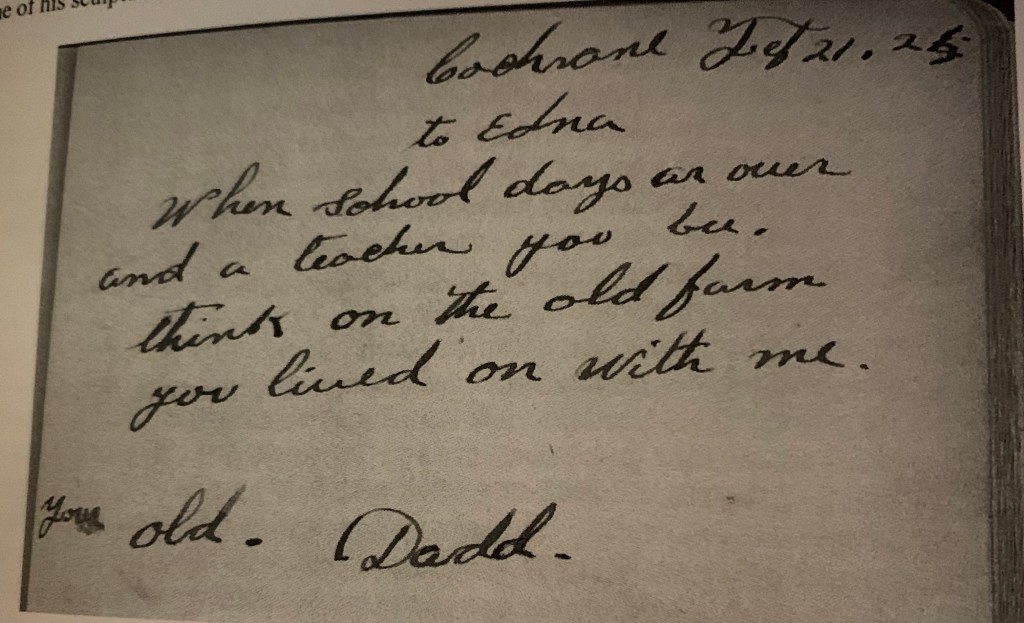
My Dad owned a farm north of Cochrane and sometimes when he would go up there to plough he would take me with him for a few days. We batched in the big house and I remember thinking he was a grand cook. He would fry potatoes mixed with bread and onions somehow and I just loved them. There were plenty of prairie chickens around and his fried chicken was delicious. I would sit on the plough with him and watch the willow roots turn up and to me they looked like people, some dancing, some family groups, some bent to the storm. Years and years later I was so thrilled to see someone else (an artist) had the same fantasy about roots – only used cypress roots and I only wish I’d bought one of his sculptures while they were still in my price range.
We had a piano which my mother played and later Ruth took lessons. Alice Andison and Dolly Mortimer used to come and play with me occasionally and all Alice ever wanted to do was play the piano. That wasn’t much fun to my way of thinking but I liked to play at Alice’s place, she had a really cute playhouse built for her in their yard.
There was a big high board fence around our barn. That corral would hold a couple hundred heads of horses I think and often it was full. I loved to sit on the fence and watch them halter-break colts around the snubbing-post in the centre.
Burnhams lived down near the racetrack, where the Burnham-Quigley brick yard once was, and I chummed with Annie and Vella Burnham. They had a lovely cool milk house with a sod roof covered with lush green grass and yellow dandelions. We used to go in there on a hot day and drink buttermilk or fresh milk. Mr. Burnham and my Dad hayed land opposite Midford. We loved going out in the hayfield with them.
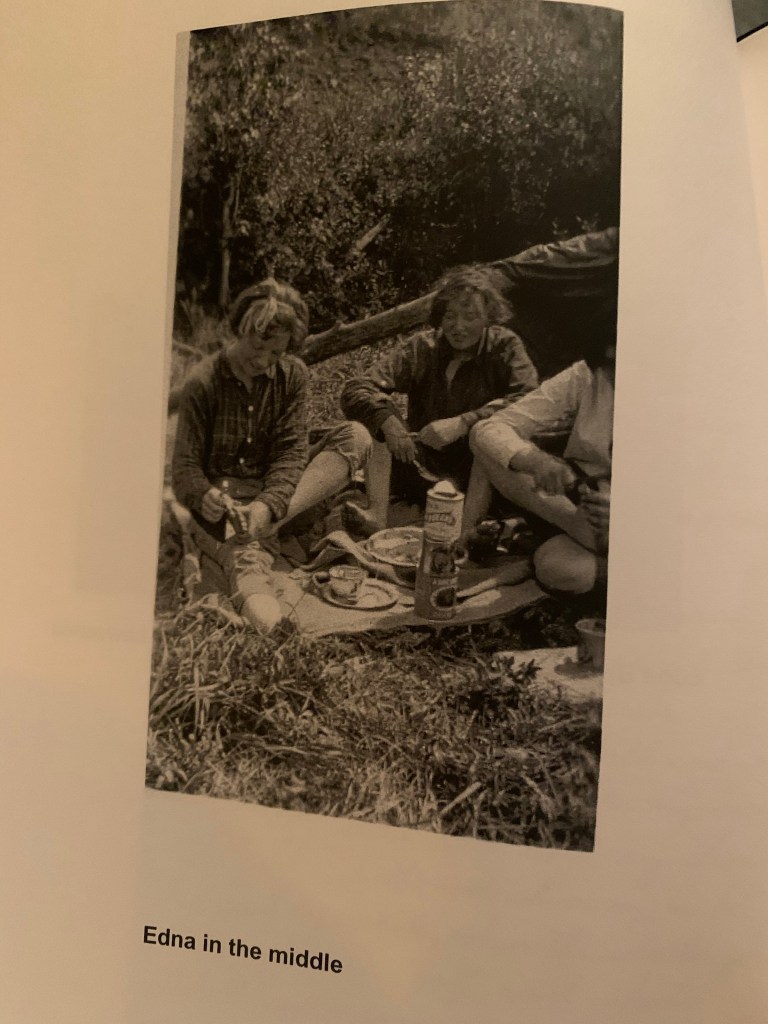
When we moved out of Cochrane (sold our home to Bob Armstead) I at last got a pony of my own. But what a horse! You just couldn’t make him move off a slow walk. We bought him from Mrs. Ripley who lived up Big Hill Creek. I had to ride him to school but always felt I’d be just as well off walking. Finally my Dad got me a lovely little Welsh pony called “Polly” and I began to enjoy the ride to and back from school in Cochrane. It was a lovely path I followed down a ravine where once there was a stone quarry. Then along the Big Hill Creek. I still think it is one of the most beautiful spots in the country. Jean Russell spent all school holidays with me at our place or sometimes at her home in Didsbury. When at our place we rode over every foot of that Big Hill creek country. We would pack a frying pan, a tin of beans, and some bread and sausages and would build a campfire and cook our lunch up at the Big Hill Springs. How natural and beautiful it was then, with the petrified rock ridge at the head of it. That rock wall is gone now, the rock was taken to Calgary due to the distinctive red rock.
When we first moved to the farm we bought a heard of milk cows from Sid Chester who then moved into Cochrane to live. There is no way I could ever work up a love for even the nicest milk cow, but I did have to help with the milking now and then. We also had a small flock of sheep and I loved the lambs, but the whole flock was such a nuisance, always getting into a field where they weren’t supposed to be. I am sorry to say that any affection I had for them was worn pretty thin. Bob Hogarth used to come and help my Dad shear them and we always enjoyed his visit. To me, the pigs had more character and personality than either the cows or sheep. One old sow must have been a great grandmother many, many times over and she was very wise. The darling little ones almost talked to you – yes I learned to talk Pig Latin at an early age. That old granny sow could smell a storm coming days before it came. She would fill her huge jaws with hay or straw and build up her nest. Incidentally, their nest was kept spotlessly clean, they always just used one area for a toilet. Recently when I was in Africa quietly stalking some wild rhinoceros, our guide said “They are quite near, over there is their community toilet”. Some folks thought he was joking, but anyone who knows anything about the pig family knew he was in earnest.
Pigs have such huge families there is nearly always one little runt in the bunch. Once I made a pet of a runt just to give it extra feed. The clock in its tummy kept better time than any old CPR dollar watch. It would come over the hill, down to the house squeaking every foot of the way until it reached the kitchen door and got fed promptly at the same time daily. One day when we were away and didn’t get home until long past his feeding time he was gone, and gone for days. About a week later a neighbour, “Mrs Adams”, about three miles distant, met my dad in Cochrane and said “You know, an funny thing happened the other day. We were sitting in the kitchen with the door open and a tiny little pig with a can stuck on hits head came running in as if he owned the place.”
Here’s another remarkable story about a pig too. My Dad must have liked pigs quite well too and once when we were shipping cream to the creamer he had an excellent crop of rye. He got the bright idea of buying buttermilk from the creamer, mixing it with rye chop, etc and feeding what looked like marvellous gruel to the pits. They died. He was so upset he just couldn’t believe all that good food had killed them. So he got a team and dragged a huge big dead pig out behind the barn, sharpened a butcher knife and went to the swollen carcass to preform an autopsy. He put his foot on it and there followed such an explosion as has never been seen before nor since. My Dad claimed it lifted him off his feet, hit him square in the face! My mother heard him calling and went out to see him coming towards the house. He would walk a few feet then, stop and vomit, then swear like you couldn’t imagine, then walk a few feet more. Mom didn’t know what was the matter with him but she knew he stunk awful and was heading for the house. She wouldn’t let him in but threw some clean clothes out for him and made him bath and change outside and bury his dirty clothes. He never experimented feeding pigs fancy feed again.
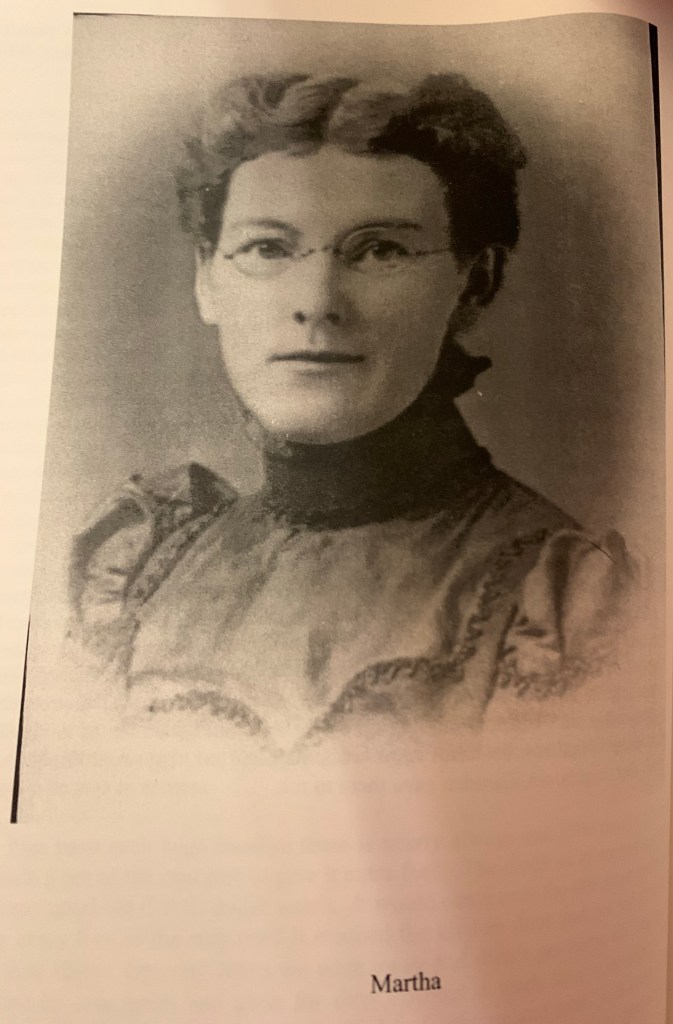
My mother was a lovely, frail little lady. One day when she went out to gather the eggs she accidentally put both feet in a binder-twine off a sheaf where we had fed the livestock and neglected to cut the twine. She fell down hitting her nose on the edge of the egg pail; it left a slight scar for the rest of her life, but she often laughed about it. Once someone gave me a beautiful little bantam rooster. He had a marvellous arched silky tail, brightly coloured. I called him “Andy” because he reminded me of Andy Chapman, our postmaster. I had two beautiful snow-white pigeons too; they would light on my hand for feed. Our neighbours, Camden gave them to me.