happiness

Letters from “Jack the Soldier” during WWII

I have no idea how my grandparents knew Jack, but there are several letters here from him. Some are from Camp Shilo in Manitoba where he went for training, and some are from overseas.

One of my favourite university classes was the history of Canada during the World Wars, and so I find this kind of stuff fascinating. I don’t think I’ve ever seen photos of Camp Shilo before, certainly not “real” ones that didn’t come from history books or archives.

Anyway, here’s the first of the War letters. Enjoy!

Sun on July 1940

Dear Percy and Edna

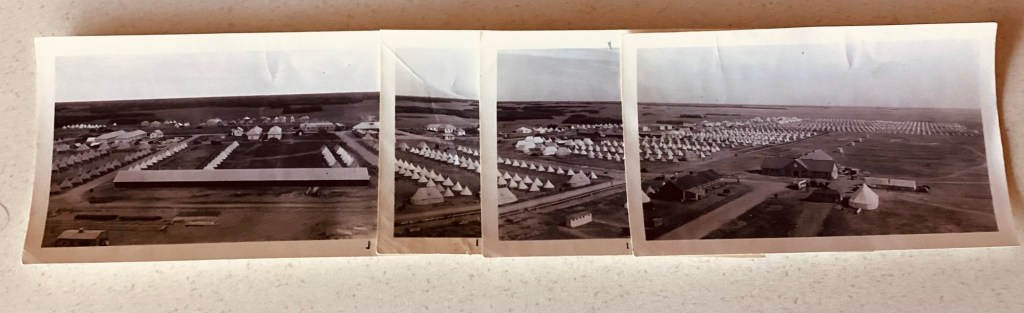
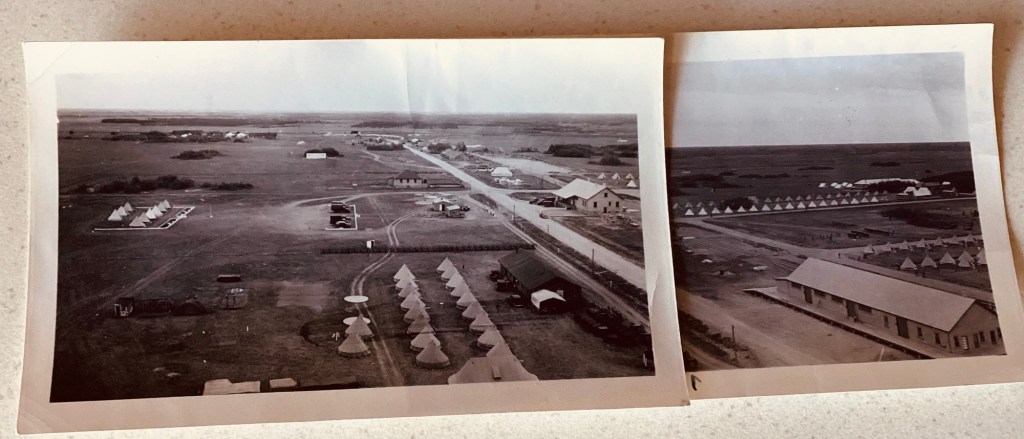
Well I am just raring to go. I left Calgary last Tuesday, and arrived here at Shilo Wednesday about four o’clock. It sure is an impressive sight seeing this camp for the first time, rows upon rows of tents, lined up in mathematical precision, and everything is slick and span, which seems to be part of the soldiers deities.

The first time a person comes here, a tension, or underlying excitement seems to grip one, all the hustle and bustle and stirs of the camp seems to change the atmosphere, and unconsciously one gets adapted to the rules and regulations of the camp.

I am still in the awkward squad, but I hope to be up with some of the other fellows in the next couple of weeks, who have been here a while, and as I like the work, and take an interest in it, I get along a lot better than lots of those, who find drilling just monotonous drilling.

The first time that a bunch of us new recruits got together for drilling was sure an experience. The sergeants in charge forgot to speak English and it is really confusing the first time one yells “A-Hee”(???) that he means stand At Ease. The army has more abbreviations for commands than you can shake a stick at and everyone seems to accent them differently.

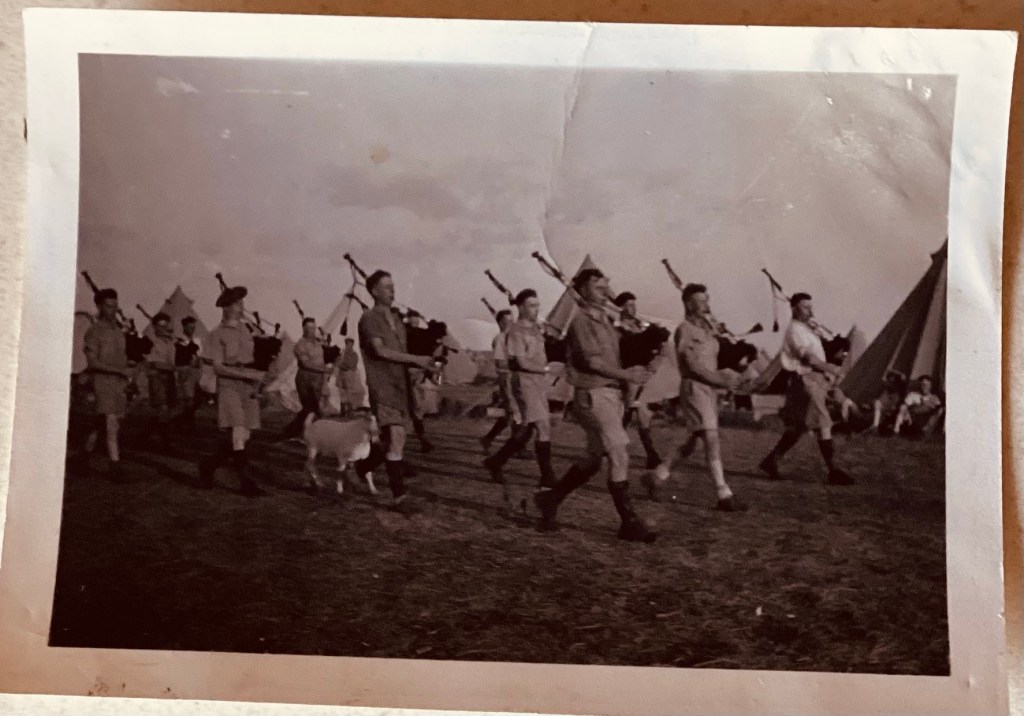
One of the finest sights is to watch the Highlanders marching to the skirl of the Pipes, the gay colourful plays, and the sound of marching, everyone moving with automatic precision sure stirs the blood, and makes me proud to belong to this unit. There is a great deal of rivalry existing between different units, sometimes not so friendly at that and new recruits soon get to possess a possessive feeling concerning their unit and think it superior to any other.

I sure was disappointed at not being able to get out to see you before I left, but leave is hard to get unless one has been in the army six months or more but I’ll try and get out there the first chance I have but in the meantime I’ll write and let you know how things are going. I’ll enclose some snaps of the camp from time to time, and I’ll ask you to keep them for me until I get back, as they will be good souvenirs to have.

Many of the boys that I became aquatinted with from around Lethbridge are here, and and as everyone is so friendly I haven’t had tome yet to get lonely.

I haven’t come across Bill Harris since I came here, but perhaps I’ll see him if he still is in camp, it is quite hard to find a certain person among so many thousands unless I know his company or Number.

It seems as though the next page/pages of the letter are missing. Not sure if the army took them, or if over the course of the last 80 years things just vanished. However, there are lots more letters from “Jack the Soldier” as well as several photos. So, I will continue to share what I have and be grateful for that!

Panoramic photos before they were a thing. These photos had directions to overlap them so that the entirety of the camp could be seen.
A little bit more of the camp that didn’t fit into the first set of photos
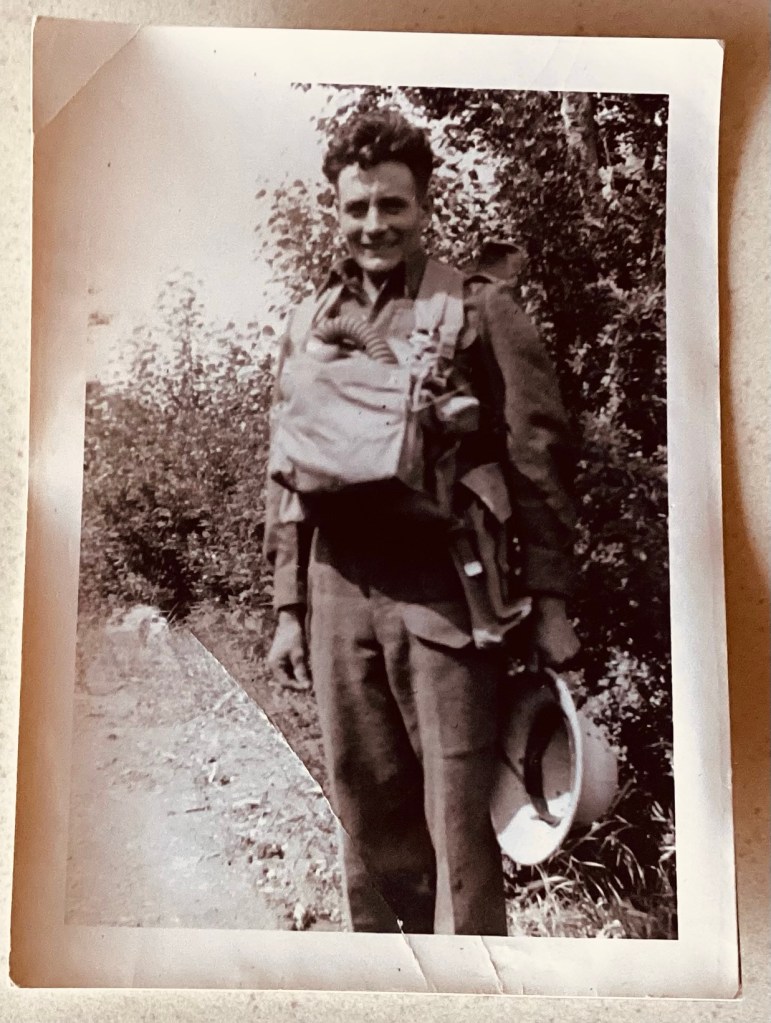
Jack Martin. Signed up June 29th (1940) at Lethbridge, Alberta. M11915, Calgary Highlanders C-A-S-F
Cameron Highlanders practicing. Shilo Camp. The Goat is their Mascot (July 25, 1940)
Standard
happiness

Old Fashioned Love Letters ❤️

My Grandpa has made me realize that I’ve never been properly courted by a suitor, particularly not by someone sending me good old fashioned love letters. We have really lost something with the move to digital methods of communication over that of paper and pen. Not only are the words beautiful, but the penmanship is magnificent. I remember being told that my Grandpa was born left handed, but had it smacked out of him with a ruler when he started school. As a fellow leftie I was grateful the days of ruler rapping on knuckles was a thing of the past and I was able to learn to write with my left hand. His writing though was impressively neat and clear and the ups and downs of the pen quite attractive to look at while reading.

I’m reading these letters, realizing that they are dated 10-11 years before my mom was born, a couple of years before my grandparents were married, while they were getting to know each other. In late 1929 to early 1930, there was a period of a few months where my Grandma accompanied her mother to Ontario to visit their family out there, and it seems this was in the early stages my Grandpa courting my Grandma. Hence the letters.

My Grandpa talks of the moon, of the chinook winds blowing, of the creek, and ties it all to her – to my Grandma – and how he feels about her.

Why don’t we do this anymore? They’re beautiful and moving and I feel so honoured to have a little peek into their private garden where their love was growing.

And while there’s talk of cows, it’s not only cows. It’s about horses (yay) and which one he thinks she would like (like me one of the best ways to get to Grandma’s heart was through horses it seems). It’s about the people they both know and what they’re up to. It’s about any gossip she should know. Mostly though his talk was about how much he missed her and how he was looking forward to her being back home.

They are so romantic and sweet and I feel very blessed to have read them. I know life for both of them was also full of challenges. Both world wars, the depression of the 1930s (while they were newly married and having babies), the ups and downs of ranching, the impact polio had on their family, and just the regular stresses of life. And yet, here in the midst of it are these moments of tenderness.

It’s beautiful ❤️

Standard
happiness

Anxiously awaiting her arrival

Waiting for baby! This little treasure is a letter my grandpa wrote to my grandma while she was in Calgary waiting for birth of their first child. My aunt wasn’t born until March 13, so my grandma had a bit of time waiting at this boarding place for her baby to come. I’m sure it was difficult on both of them (but extremely kind of my aunt to arrive just before calving started haha).

They must have been so excited. Hopefully I find another letter from after the baby was born!

Buster seems to have been the name of many of their dogs. My childhood companion on many of my adventures was their last Buster and I loved him dearly.

Jumping Pound

Mon, Feb 25th, 1935

Dear Edna

Here I am and it seems like old times writing you again. Only things are a little different eh.

I hope you are feeling fine and not so lonesome as I. Gee things sure are dull around here now. Talk about quietness. Even Buster’s lonesome every morning, he goes into your room to see if you are home and comes out again with a kind of a dejected inquiring look.

Annie went to the Old Timer’s in /Cochrane with Jack and Nan and the rest. Had a good time etc. the dance here for next Friday is to come off on Monday cause May Bowlen flirted with Frank Sibbald and got him to set the date to suit herself.

A social credit meeting is being held in the hall tomorrow night. I wish you were here and able to come. I don’t know who the speakers are.

The night I came home from town I got on my horse and rode to George’s with Archie so as to be able to ride to the Stoney Reserve next day. We left George’s at 7 o’clock in the morning and didn’t get home until 7 at night.

We went clear up to the Kananaskis where we went fishing two years ago and found one head of Sam’s cattle. It was running with some Indian cattle. There is a relief camp up there now making roads. I saw some nice little fir trees I’d like to bring home and transplant. Maybe next summer we can go up and get some.

Say, do you know what? Charlie has accepted my Dad’s offer on his place through Tom Cairns. The other fellows couldn’t collect enough cash. I don’t know whether Dad wants to close the deal or not. He is going up to see him tomorrow. Better keep this under your hat until things are official.

I have been riding all day – until half past three. Harold is feeding the cattle in Springbank.

How do you like your boarding place? I hope you are having a real holiday. I wish I went in on Sunday in a way as it seems so long till next Sunday unless “things” happen in the mean time.

I got the battery charged on the Delco again. I started to fix the chair and found one spring missing. Looked everywhere for it but “could no find” so I’ll look for one out of an old bed spring somewhere.

There is a letter from Jean and I am readdressing it to you so look for it too. I thought of opening it and phoning the news to you as I thought she might be possible going to Calgary during the weekend. But I hate opening letters for anybody.

Frank Sibbald just phoned and gee I was all aquiver as I thought it was a central ring. I sure with the suspense was over.

Well “sweetheart mine” I am plumb out of news so I guess I’ll have to quit anyway. I did pretty good for an old codger and here’s hoping you are fine.

From your old man

Percy

Standard
happiness

A convocation of eagles

We were driving to town yesterday and looked at the slough on the way by to see if the swans were still here.

As an aside, a couple of weeks ago the girl and I were out in the yard when we heard what we thought was the strangest sounding clown car going by on the road. Turns out it was the honking of a flock of swans. Much different than the honking of a flock of geese these guys were – an elegant looking, but clown car sounding flock flying overhead. We are still laughing about it.

Anyway, we looked over and to our surprise and delight, instead of
swans there was a convocation of eagles. Is 4 enough for a convocation? Either way, they were magnificent! I love eagles and have been blessed with several eagle sightings this year. There are many interpretations of the significance of seeing eagles – to me they represent courage, strength, power, bravery, independence, and a connection to the divine. Added bonus is how amazingly beautiful they are.

How amazing is this???
God’s love and beauty
When I looked at this photo, I couldn’t figure out for the life of me what the eagle on the far right was doing.
The funky chicken???? What on earth??
Oh, never mind, it was just a crow flying in front of him.

Standard
happiness

Give all to love

One of my favourite poems – maybe my absolute favourite one – is Give All To Love by Emerson. As with Thoreau, I first discovered my love for him as a young adult in university English class. Actually, I not only discovered Thoreau and Emerson, but I discovered transcendentalism and with that a kind of “home” that I have danced in and out of over the years. In reality, I didn’t discover transcendentalism so much as it found me and pulled me towards it.

According to vocabulary.com, transcendentalism is “a philosophy started in the early 19th century that promotes intuitive, spiritual thinking instead of scientific thinking based on material things.

There are three main principals – individualism, idealism, and the divinity of nature. I think one of the main components that drew me to these transcendental writers was their belief that nature is sacred and is a powerful source of both spiritual and moral wisdom that we as humans are to connect and live in harmony with.

Their writings make me feel happy and connected to the Divine in any case.

I have to say, the one visit I made to Concord years ago has left me wanting to go back and spend much more time there exploring and sitting in the space where thinkers I have admired for years spent their time. I loved New England.

There’s a big part of me that wants to love poetry, there’s another part of me that often gets bored really quickly with a poem and I often struggle with wanting to enjoy what I’m reading and wanting to poke my eyes out so I don’t have to read anymore (a bit drastic, closing the book is probably more accurate.) When I find a poem that grabs me, it becomes part of my soul and I carry it with me. As I do with this one.

From the first time I read it, the last stanza has been imprinted on me. I’ve thought about it on and off throughout the years, and it helps hold me steady. I love it.

Give All to Love


BY RALPH WALDO EMERSON

Obey thy heart; 

Friends, kindred, days, 

Estate, good-fame, 

Plans, credit and the Muse,— 

Nothing refuse. 

’T is a brave master; 

Let it have scope: 

Follow it utterly, 

Hope beyond hope: 

High and more high 

It dives into noon, 

With wing unspent, 

Untold intent: 

But it is a god, 

Knows its own path 

And the outlets of the sky. 

It was never for the mean; 

It requireth courage stout. 

Souls above doubt, 

Valor unbending, 

It will reward,— 

They shall return 

More than they were, 

And ever ascending. 

Leave all for love; 

Yet, hear me, yet, 

One word more thy heart behoved, 

One pulse more of firm endeavor,— 

Keep thee to-day, 

To-morrow, forever, 

Free as an Arab 

Of thy beloved. 

Cling with life to the maid; 

But when the surprise, 

First vague shadow of surmise 

Flits across her bosom young, 

Of a joy apart from thee, 

Free be she, fancy-free; 

Nor thou detain her vesture’s hem, 

Nor the palest rose she flung 

From her summer diadem. 

Though thou loved her as thyself, 

As a self of purer clay, 

Though her parting dims the day, 

Stealing grace from all alive; 

Heartily know, 

When half-gods go,   

The gods arrive.

Standard
happiness

Compassionate friendships

The letters I have been reading have highlighted for me the deep, caring friendships that Grandma had with some of the women in her life. I wrote yesterday about her friendship with my Godmother, and how they bonded together after Uncle George died. There has been another set of letters I’ve found from Aunt Gertie that have helped me see that the kindness I remember emanating from Aunt Gertie really seemed to be a deep part of her personality – of who she was – and also how Grandma and Aunt Gertie (who lost her husband, another Uncle George, in the 1950s) shared a bond of friendship that I don’t think I ever appreciated.

Grandma and Aunt Gertie passed away exactly 2 weeks apart in April of 2004. It’s hard to believe it’s been that long ago, and also hard to believe that much time has passed. As the mom of an almost 20 year old, I feel that odd passage of time on many levels.

But way before that, when they were women living out in the country in a time when isolation was a way of life, they forged a friendship. I’d imagine it began during the time that Aunt Gertie stayed here with Grandma and Grandpa, before she married and moved onto have a family of her own. I only have half of the letters they sent to each other. I have to guess from things Aunt Gertie says to Grandma what it was that Grandma had written in her letters.

But there were times when Grandma had major life events (tragedies) occur and there would be a letter from Aunt Gertie giving love and support. But more than that, she showed deep compassion and understanding for whatever issue it was that Grandma was dealing with. She would open her heart and share deep emotions and private life events to attempt to help Grandma feel less alone and more loved.

From what little I know about Aunt Gertie’s life, she certainly had some struggles and challenges and heartaches to deal with. Yet whenever I would see her I was greeted with a big smile and made to feel welcome. It is the same sense I get of her from the letters I have found. It’s inspiring, the reminder to be kind, be compassionate, be thoughtful to others no matter what.

There are so few stories of women from the past, their histories being lost and the importance of their lives forgotten. I feel very honoured to have found the treasure of “voices from the past” for some of the women who came before me.

Standard
happiness

Friends that become Family

There’s the family that we are born into, and then there’s the family we create through friendships. There’s the saying “blood is thicker than water,” but sometimes that friendship bond becomes blood-thick, possibly thicker.

We have a family who joined with our family in that way. The bond was created before I was born, so I grew up thinking of them always as family. For those of you who knew my Godmother, you know what I mean when I say Auntie Mary was a one of a kind special person. I always felt like I had a fairy-godmother like Cinderella had. I didn’t get bippity-boppity-boo’d into a magic dress and carted off to a ball, but I did get showered in love from her. I always felt so blessed to be her godchild, and I still feel blessed that her daughter remains part of my connected family life.

I found a letter from Auntie Mary to my Grandma a few weeks after her husband (my Uncle George) died. I was only 8 when he died, but I remember the day well as it was Christmas Day. We were out on the ranch, there was the usual skiing, sledding and general fun and games of Christmas until everything changed.

The letter was a letter of thanks, thanks for support, thanks for love, thanks for friendship, thanks for being family, thanks for understanding and compassion. All of the things Auntie Mary gave to others, she was thanking my grandma for. It was really heart warming and love-ly to read the love and gratitude shared between these two women, both of whom I always loved and admired. Sometimes the strength people find to deal with hard times comes from deep within, from our faith, and sometimes it also comes from the love and compassion of people we trust in our lives.

The friendship bond that can exist between women is unlike anything else. I think sometimes we don’t put enough emphasis on how important it is to have good friends, people who will be there through all of life’s hills and valleys. I’m so grateful for these letters. They are such a personal way of communicating, an art that has pretty much been lost – I treasure them and love the old stories and memories.

Standard
happiness

Edna Copithorne: A true Cochranite

There have been some really fun and interesting newspaper clippings that I have come across. Things in this house that look like junk – like old newspaper – rarely are it seems. Little treasures everywhere. You’d think in a house where nobody seemed to ever throw things away that I would have found those fossalized sea shells she talks about, but alas – no – so far anyway. Also no stove dynamite, so that’s a bonus.

Here’s a little story about Grandma that was printed in Cochrane This Week back in 1999. How Cochrane has changed since then!

Edna Copithorne, A True Cochranite

By: Gary Stevenson, for Cochrane This Week, February 9, 1999

Edna Copithorne is a true Cochranite. she was born in Cochrane, educated in Cochrane, and married in Cochrane. Edna is the daughter of Frank and Martha Brown who arrived in Cochrane with their daughter Ruth from Cobden, Ontario in 1904. The family homestead just north of Cochrane at the head of the coulee leading to Big Hill Springs. After four years, Frank Brown bought four lots in Cochrane and built a house, barn, corral and other out buildings.

Edna remembers the school and especially one of her teachers, Miss Bruce, who Edna says was a real pioneer teacher. The school is still standing and is now the Masonic Hall on Centre Avenue. The Bruces lived where the old police barracks are. When they first came to Cochrane, there was a huge pile of buffalo bones, as high as a hill, beside the station. These bones were shipped to be used in the sugar refining process.

Edna remembers standing at her bedroom window and watching a tremendous grass fire on Big Hill, a fire which threatened the town. It seems that a gentleman had been at the hotel celebrating some event when he was given a cigar. He lit it and started for home, going up the old Retreat Road (now closed). He did not like cigars so when out of sight, tossed it away. It is thought that this was the cause of a fire that had most able-bodied men fighting for hours. Imagine carrying buckets of water up a 700 foot hill! The fire fighters ran out of water except for the well at Frank Brown’s, and this was what saved the day.

Another well figures in Edna’s memories. In 1918, the Bruces sold their home in Cochrane and bought Bruckshaw homestead three miles north of the village. One of the necessities of life was a good well. This was excavated with the help of Tom Spicer and Orr Fenton. When the hole was of sufficient depth to use dynamite, Orr Fenton was lowered on the windless and set the charge. He pulled up and the men waited for the blast, which had failed to occur. So Orr went back down only to find the fuse still sputtering. They had to pull him by hand because the rope jumped the pulley and got him clear just as the blast went off, shooting dirt and rocks high in the air. Edna recalls collecting some of these rocks and to her amazement, they contained fossilized sea shells.

The next day, her dad went into the house to find a bucket sitting on the back of the stove. When he looked in it, he found sticks of dynamite frozen together. Orr had put them there to thaw them. Edna says she can’t repeat the words her father used.

Edna met her husband, Percy Copithorne, at a dance and they were married November, 1931. They settled on Percy’s property at Jumping Pound.

Edna remembers the Indian artifacts that could be found nearby where the Indians used a cliff to drive buffalo over. Unfortunately, scavengers picked the relics and today, the area is barren of artifacts of Indian life at the time.

But life went on, despite the Depression and the drought. Edna says, “1935 was the driest of several years. They were hard times, but we didn’t stop to think about them.”

There was an annual picnic organized by the McAllisters on an island in the Bow River. Dances were held. Edna’s husband Percy played the violin. Jack Copithorne was the drummer, and Percy’s sister Martha (this must be a typo? Margy?) played the piano. Later Bill Kumlin came into the band with a saxophone.

Sometimes, before the Jumping Pound Hall was built, they would load the piano into a wagon and cart it five miles to another homestead and hold their dance there. “I remember when there were no fences. Now everything is coming at us on all sides. It’s getting harder and harder to ranch. How long before Cochrane disappears under Calgary’s sprawl?” Asks a true daughter of Cochrane.

I remember as a child there being teepee circles (made out of rocks) in a field near us. The way I was told, it wasn’t scavengers, but researchers (I’ll use the term loosely) from the University of Calgary who came out and took everything so they could study it. I remember my mom being quite upset about it because what good were the rocks when they had been removed from their placement, from their setting? They were just rocks again. I’m sure there were other instances of people taking artifacts, I may or may not have spent several hours myself looking and hoping I’d find something. I would typically come home with pretty rocks from the creek which became less pretty once they dried.

Standard
happiness

The Accident (A poem)

I found a poetry book Grandma wrote when she was a teenager – along with a few school friends from what I can tell. Most of the poems in this book are written by her, but there are several written by other girls – I assume classmates of hers.

I had previously found a written copy of her poem “The Accident” that didn’t have the explanatory story at the beginning of the poem. I was left wondering what had indeed happened to poor Jean, although I knew by how history had played itself out that she had in fact lived through this accident and gone on to live a long and hopefully happy and fulfilling life.

There are some really beautiful poems in Grandma’s book, about the landscape, the snow, the mountains, even about the passing of my great grandfather – her father in law. But this poem about her best friend eating dirt on the way home made me smile. This friendship clearly was incredibly important to Grandma. There are letters spanning her entire life from her good friend. It seems very “Anne of Green Gables” with her bosom buddy Diana – the type of friendship I have always aspired to have.

The Accident – by Edna Brown, 1924 (Grandma would have been 16 at the time)

One Day Ruth and Jean rode to town and coming home, Jean’s pony fell and threw her off, she was unhurt except for the gravel taking the skin off her elbow. While she was lying on the road, Ruth shouted at her “Are you killed yet Jean?”

There once was a dark eyed cowgirl

And her name was Jean Russell

She used to ride a roan pony

When she wasn’t in a hustle

But one day a storm rose from the west

And both speed and steadiness were needed

Maybe I’d better not tell the rest

Because in supplying these things that pony

Never succeeded

However Jean was home before the storm

And how she did it I for one with wonder was filled

One place from the road they have torn

And there Jean was supposed to have been killed

They took the top off a rise in the gravelly trail

But when they reached hone we were glad to find

Jean alive and telling the tale

With a few grains of gravel from her elbow to be mined

Standard
happiness

The Prairie fire that drove us from school

I was digging through our archives (aka long abandoned boxes) and found an article written about the 1936 fire Grandma spoke of (If you’re not sure what I’m talking about you can find her-story about the fire here, and photos of the fire here). Grandma makes a cameo appearance in this account of the fire.

This is an article written in Grainews from June of 1995, written by Ronald Wallace:

The Prairie fire that drove us from school

It was Nov. 20, 1936, when the Brushy Ridge School house burned down. It was in the path of a Prairie fire.

I was nine years old at the time. My two sisters were 11. We were party f a group of a dozen kids who had braved the wind, the smoke and the smell of fire to attend classes at this school.

The fire got its start away to the West, in what is now known as Kananaskis Country. Probably the day before. Sometime during the night, the wind picked up.

Coming home from cousin Kass’s birthday party that night, the air was full of the smell of smoke. We kids paid scant attention to it, however. We were too full of cake and ice cream and the fun of the party.

The next morning, the wind had become strong enough to blow the soil off summerfallow, as it had done off and on all fall – ‘36 was a dry year. A lot of crops didn’t make it that year. The Depression was working its hardships on many people.

The acrid stench of the smoke was even stronger than last night, I thought as I bridled and saddled Queenie for school. The wind and the dirt had us ribbing our eyes already. We weren’t looking forward to the five minute ride. In fact, it was so dark we were a bit scared.

As we pulled into the school yard, the wind gusts ripped and tore at us with an awful frenzy. It took two of us to wrestle the barn door open enough for the third to get Queenie in.

We ran for the school. The giddiness I felt as the wind snatched my breath and smoke and dirt swirled around was scary.

About 10 o’clock the schoolroom got so dark we couldn’t see the blackboard. No electricity in those days.

Miss Davis was the teacher. The school sat directly across the road from the Callaway farm.

The school vacated

At 11 o’clock, Mr. Callaway came over to the school to talk to Miss Davis – out in the cloak room. When she came back in she asked Carl Wilson, who would have been 13 or 14 at the time, to run up the road about half a mile to the Messer place to warn them of the approaching fire. She told the rest of us to get our coats and run across the road to the Callaways. The noise of the wind had me totally spooked. Once we cleared the school, the same giddiness and panic took hold of me as I gulped and sucked for air.

My sister Doreen had hold of my hand, and if it wasn’t for her, I don’t know how I would have got across the road and into the Callaway’s house.

Their house was protected on the west by Spruce trees. The smoke and the wind billowed and screamed through the branches. The front and the back doors of the house were open as people rushed in and out.

It was dark in the kitchen. Mrs. Callaway was heating up porridge for Evelyn, the baby. It was burning. It took her a while to realize it. The smell of things burning was everywhere.

Some live coals blew in the back door. Joe, the hired man, stamped them out and tried to shut the door. The wind was such it forced him to put his shoulder to it.

I can still see his neck bulging with the effort. My sister Eileen told me afterward that Joe had helped get us kids across the road. I often think of this because, at the time, most of us were a bit afraid of Joe. He was Czechoslovakian and had a strong foreign accent. He seemed to us to be a big boy with a gruff voice.

Rushed out of area

Ted Callaway had a big blue car – a Nash I think it was. He put as much of their belongings as he could in the front seat along with his wife Mamie, his young son Bob and Evelyn. In the back seat were nine of us, ranging from seven to 16.

The wind hit us broadside as we haded north to Cochrane. It did its best to upset us. The car would lift and settle as the gusts took hold of it.

Miss Davis, Carmen Barkley, Vernice Towers, and Carl Wilson were left behind. They ended up at hte Edges’ house, which was almost a mile east of the school. I can;t remember how they got there, but I think one of the Edge boys picked them up. For a period of time, they were reported missing.

Once we crossed the river coming into Cochrane, the visibility cleared some, the smell of smoke was not as overpowering and the wind-driven dirt didn’t hurt as much.

We went to the Cochrane Hotel and waited. After a while, a reporter from Calgary came along. He asked us a lot of questions and then lined us up and took some pictures. We were a sorry-looking lot! He asked us some more questions and then took us over to the cafe for doughnuts and hot chocolate.

People started to drift into town. Haggard, worried, desperate people. The Coelens milked cows a few miles west of the school. They lost everything.

The Arnell’s, also to the west, had pigs and chickens roasted as their buildings went up in flames. Their house and everything in it quickly burned. They escaped with little more than the clothes they wore.

Mrs. Towers came in looking for her daughter. When she found she wasn’t with the rest of us, tears ran down her face. I remember being somewhat sobered at this. I hadn’t seen too many adults cry. I remember saying “I wonder what our folks are thinking.”

School’s on fire

George Wilson lived a mile east and a mile south of the school. His oldest daughter, Muriel, was at home. She was a slim girl about 18 or 19 at the time. Somehow, through the smoke and dirt she saw the school on fire.

Although she wouldn’t have weighed 100 lbs, she ran with the wind a mile east to our place to sound the alarm. Then she turned around and ran back home again! Into the teeth of the gale that was later reported to have gusted up to 90 miles an hour.

Dad threw a shovel, an axe, an 8-gallon can of water and some sacks in to the old Ford car, picked up hose brother Bill and headed for the school. They went through the back pasture, got out on the road and had only gone a little way when they ran into a large obstacle across the road. It was on fire.

Through the smoke and dirt they saw it was a “slide” or hay stacker, commonly used in those days to build hay stacks in the field. They were big wooden structures made out of logs and planks. It took four horses to move them any distance.

The wind had blown this thing uphill, out of George Wilson’s hay field, through the fence, across the ditch, and onto the road. Imagine their dismay when they circled the thing and there, on the other side, was a car half in and half out of the stacker.

Mrs. Percy Copithorne had been driving back to their ranch from Cochrane. At the school, she had swung a mile east to avoid the oncoming fire. In the near-zero visibility, she didn’t see the stacker in time and before she could get stopped, the front wheels went over the log skid. She was stuck. She was a young woman. She had a young child with her and she was expecting another one.

Dad and uncle Bill beat out the fire and chopped her free. They took her back to our place and then made another run for the school. When they got there, the school was gone and so was the barn where we had put our horse. Harry Edge came along and told them us children were all in Cochrane, but that Queenie was in a bad way. Smoke inhalation. He said when he got to her, the barn was on fire but he got her out before it collapsed. We had to shoot her the next day.

About 5:00 pm., Mr. Wellington Barkley came into Cochrane and took us all home. The wind had died down and a light rain started to fall.

It was an eerie sight driving home through a blackened and smouldering countryside. Hay stacks were still burning and so were telephone poles. Downed wires were strewn along the sides of the road.

Many stories have been told over the years by those who were caught in this fire. Stories of danger and courage and heartbreak. This one is written through the eyes of a schoolboy.

Fifty-eight years later, I can still smell the smoke, hear the shriek of the wind and feel the sting of the dirt in the air. It was quite an adventure.

There was no loss of human life, although a considerable number of animals died. It’s amazing took how the resourcefulness and ingenuity of people who are faced with disaster can still muster the will to rebuild and overcome their losses. In the ‘30s this was no mean feat!

Written by Ronald Wallace

Standard