happiness

Missing Martha Brown and other notes (writings by Frank Brown)

I found an old notebook of Frank Brown’s (my great grandfather) – it’s actually “The Cooper Notebook” from 1936, and like most things in my ancestry is agriculture related. This one seems to be about sheep, as the foreword in the book states:

This notebook is used and distributed in the hope that it will prove useful in everyday use, and at the same time, provide an immediate reminder of the more important aspects of sheep dipping and the uses of Cooper Products.”

I can honestly say that I, in my every day life, have managed to live a lot of years without knowing about the important aspects of sheep dipping, but I am a little bit wiser now. I’m still not sure that I will need it in my every day life, but one honestly never knows. I have learned a lot of things that at the time seemed useless, but then became essential to my well being so never say never.

The notebook is mostly full of people’s names and addresses, but there were several things Frank wrote about his late wife, or life in general. Poor Frank seemed kind of lost after the death of Martha.

My dear wife who died Sept 29, 1935

Always so thoughtful, unselfish and kind.

Few in this world are equal to find

A beautiful life suddenly come to an end

She died as she lived

Everyone’s friend

Always remembered.

And another one

My wife passed away Sept 29, 1935

Nothing can take away

The love a heart holds dear

Fond memories linger every day

Remembrance keeps her near.

Written by husband F. Brown

A few random writings:

Some noises are enormous,

Some are teeny small

Some make my ears all tingle

Some I hardly hear at all

Another one:

When things don’t go to suit you

And the whole world seems upside down

Don’t waste your time in fretting

But drive away that frown

Since life is oft perplexing

It’s much the wisest plan

To bear all trials bravely

And smile whenever you can.

Also:

A heart that never knew a Pain

Is like a Land without rain

Is like a land that never knows

A springtime flood or summer Rose

So let us thank our God for this

Our May-time, our December

The first embrace, the Parting Kiss

The things that we Remember

The day with neither rain or sun

Brought never flowers to anyone

Thank God for Joy and grief and strife

We live upon the Peaks of life.

As I’m sitting in Cold February weather and dreaming of June flowers I’m not sure I totally agree with him on this one, but I do love the clear blue skies of winter when they are here.

You suns and skies

And clouds of June

and flowers of June

Together

You cannot Rival for one

Hour this clear

December’s weather.

And:

Long delay in kindness

Takes the kindness all away.

The gracious life of love

Can’t ever lose its power.

When the great Scorer comes

To mark against your name

He writes not what

you lost or won

But how you played the game.

And a couple of warnings about dealing with people:

The honey bee has a red hot foot

The wasp has a slender tail

A bumblebee sits down quite hard

While the hornet turns you pale

The sting of the bee is hard to bear

It makes you ache and fret

but the sting that is made

By a trusted friend

Is the one you don’t forget.

Lastly this gem that was found on a lose scrap of paper, which gives an image I can’t quite get out of my head:

And when your time is over

And you’re a hopeless wreck

May you step back through your

Asshole and break your bloody neck

Standard
happiness

Cochrane Hill – a poem by Edna

Grandma sure loved her hometown. She told so many stories , sharing her love for the little village where she was born, that is now a small city pretending to be a town. I am not sure when this poem was written, it was found with articles from the 1920s, but this was typed out, so I’m assuming it was later on that that. However, if Grandma could see now “the hill, now streamlined to follow the mode, as tourists go speeding….” It certainly isn’t anything resembling a cow trail anymore. The mountains and the view though, they’re the same. It’s still a beautiful little area, it’s home.

Cochrane Hill

The foothill country in the days that are gone,

Had trails that led you hither and yon.

And many a well worn path was trod,

Till great, deep ruts were buried in sod.

One of those trails is history now,

A trail that’s not forgotten somehow.

It’s a long, long slope that curves until

You know you’re descending the Cochrane Hill.

The hill, now streamlined to follow the mode,

As tourists go speeding where Natives once rode,

No more is a cow trail, but a road that will last

Though present day traffic is heavy and fast.

Decending this hill you come into view

Of the beautiful Bow, all misty with dew.

And the Rockies, majestic, mighty and tall.

Truly a sight remembered by all.

You may like the view from a plane in the air,

Or even the view from a Pullman chair.

But just about sunrise when morn is so still,

Oh give me the view from Cochrane Hill.

Standard
happiness

Majestic Moose Mountain

We had our trees trimmed last week, and for the first time in over a year we have a mountain view again.

For the last several days, I have spent a great deal of time standing in the kitchen or on the deck, holding my cup of tea and looking west at Moose Mountain. I had forgotten how much I love doing that.

For as long as I can remember, Moose Mountain was “the” mountain that we talked about in our family, both immediate and extended. It’s fascinating to me how many of the houses in my area have been built making sure the view is of that mountain.

When I look through my photos, it’s by far the most photographed mountain in my gallery (and I’ve got several hundred random mountain pics).

It brings me joy, it grounds me, it brings me peace, it brings me home.

Standard
happiness

A Brief History of the Ranch part II (FGK 87)

I quite like the name Upside Down Teepee Creek. It’s a bit long, but I could get used to it. I do have to add that the only part of my recording that was quite difficult to hear was the part where my uncle announced he was retired – and that was due to all the snickering and comments from the peanut gallery. My uncle maybe retired, but he still is busy working and I would bet knows just about everything that goes on at the ranch.

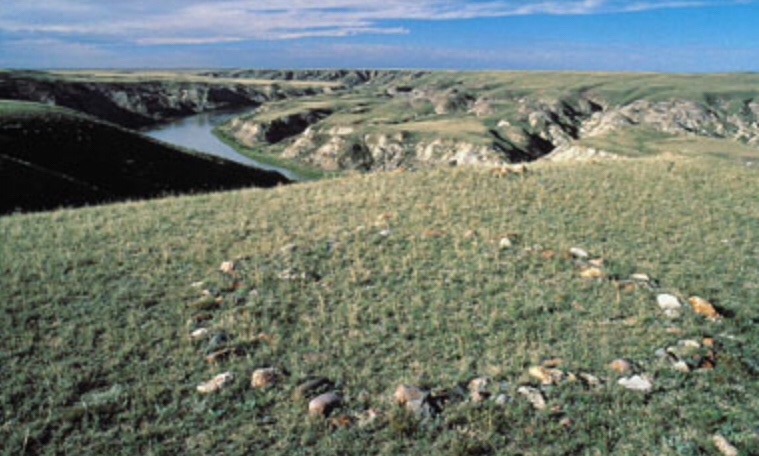
Much of my childhood was spent on horseback winding around the cliffs at the buffalo jump, or skating and swimming in the creek below it. I remember finding arrowheads and other artifacts – no idea what happened to them, we probably left them there. One of the more powerful lessons I had in leaving things untouched was as a small child when the university came out to examine the teepee circles that were in the field next to us. I remember having been taken out to see them – and from my memory they looked similar to the photo below (which was taken from This website and is from Saskatchewan). Anyway, the university’s way of “studying” the formation was to gather up all the rocks and take them away with them. My feeling was once they removed the rocks and destroyed the formation, the rocks were just rocks and all they managed to do was permanently remove some pretty cool history.

But in those days, he really built the foundation of this ranch on work horses, draft horses, Clydesdale horses. They had Durham cattle and our beef herd expanded slowly, but not as Clydesdale horses, and of course that ran through till First World War. And a good number of those horses were broke and trained here on the ranch in the haying season and whatnot and sold to farmers for the harvest. But our best customer was the Canadian army, they went overseas and there are some sad stories about what happened to those horses.

But that’s how we arrived here, and my grandfather had 4 brothers and by the time the 20s came along they had a couple of townships of land each.

So going back to the history of why we call this Jumping Pound. If you look in the history books and the written history of the Stoney Indians you’ll find out that the Stoney Indians were for the most part, pretty much back in the mountains. And you go back to when Anthony Henday from the Hudson’s Bay Company was starting out this way, he came from Fort Edmonton in 1750. The Indians that were scouting ahead, they wouldn’t come any further south than Innisfail. And you’ll see a sign on the highway “Behold the Shining Mountains” and it’s a story about Henday. And the reason was Blackfoot to the South, and the Bloods and those folks, they got horses, and horses were like tanks in those days. The rest of them were still running around on foot. That kept things kinds of off balance here. The Stoney were on the edge of the mountains, they’d creep out once in a while and the Blackfoot would move away and then they’d run back into the mountains when they weren’t. But at any rate, that’s sort of the history, and this creek over here which is Jumping Pound Creek, in those days was called Upside Down Teepee Creek and that’s a Stoney Indian term. The Blackfoot have probably forgotten all about that. But the Stoney found an upside down teepee, which is a place where they bury a chief, a famous chief of the Blackfoot. I don’t know who he was, but that was the name of the creek until the white guys got here.

Now we’re going to go back a thousand years, and this Jumping Pound creek, if you’re ever driving up the highway and you look to the north, you’ll see those high cliffs on the creek bank? For a thousand years, five thousand years – I don’t know – these Indians on foot, long before they had horses worked their way out behind the buffalo herd and manoeuvred them, maneuvered them, maneuvered them to a point where they must have given a big whoohaa and these buffalo stampeded and went over the cliff and that’s how they got their winter meat supply. So that’s why the white people when they got here called it Jumping Pound.

And when my grandfather first arrived, that was one of the big industries of the country was digging buffalo bones out of the bottom of the creek. They must have been piled 20 feet deep because they had – there was a hill over there they called “Pile of Bones Hill”, they picked these bones out of the creek bottom there and hauled them over to this Pile of Bones Hill. and then they had great freight wagons that would come over from a little town called Midford, which was before Cochrane, which was on the railway tracks on the South side of the river. And they’d haul these bones over and they’d send them over to Europe or China for fertilizer or whatever else they used them for. But that was the first industry in the country.

My grandfather got married in 1895 and he got married in Midford in a little Anglican Church in Midford, which they later picked up and moved across the river and set it up in Cochrane, in the old Anglican Church in Cochrane, if you have ever seen it or are familiar with it that’s where it came from Midford and was my grandfather’s marriage place.

Anyway, what else can I tell you?

Tell us about the pastor who got lost in the snowstorm out here – do you know that story?

George McDougall? I do

I found that sad. they had no direction

And he was travelling with the Indians too

It was just one of those things that happened, and like I told you before, there were no trees out here. Believe it or not, there were no trees out here. These hills to the west of us, it’s hard to explain that to the government, there were no trees out here. The reason there were no trees is that there were fires, and they would start with lightening and everything else. And the Blackfoot – you know how they got their name? They wanted to burn the grass, so that in the spring the fresh grass would grow up and the buffalo would come up to the new grass rather than the old grass. And they were called Blackfoot Indians because they were always walking around on burnt ground. But those hills had no trees on them. I’m sure there were some on the creek bottoms on the north side of the hills here and there but not like there are now. Like Aspen poplars, forgive me for saying this, are primary and not just weeds in my language, they’re an encroachment and have come in in the last 150 years for sure with fire control. But anyway our ranch has been divided up, and now we’re running the home ranch unit – my family are – I’m retired and I’m very proud of my family.

What more can I tell you about my community. This hall, it was built in 1927 by the locals. And was all done by my old uncle Harry who was a character in his own right. You’ll see some of his pictures on the wall, one I saw where he was making hay. That guy playing violin in the corner is my father, they had their own little orchestra here. But it was, the whole neighbourhood came together on it, and in order to fund it they formed a company and it was called Jumping Pound Hall Ltd. And we still have ownership shares.

And I think that’s about the end of my story.

Standard
happiness

In Grandma’s Words part 16 (FGK 78)

And finally we have the story of how Grandma’s kitchen came to be in her own words. I absolutely love this description. I have to say I smile every time I look at the photo of Grandma in front of the fireplace as she’s accompanied by the best dog of all time, my old friend Kayla. I don’t know how Kayla managed to get into Grandma’s memory book but I love that she’s there. I miss that dog.

I have so many memories of lying on that old red leather couch, surrounded by the overpowering smell of geraniums and reading old Archie comics. It was one of my all time favourite places to hang out when I was a kid. Although the geranium smell made me swear I would never ever have those flowers in my house, I religiously plant them in the flowerbed in the verandah just off the kitchen because that’s what was always there and anything else seems wrong. They just fit.

We decided then to tear off and build a new kitchen, level with the rest of the house. And build up the earth to be level with the back door and widen all our doors so that a wheelchair could get around easily.

At this age in my life I had enough experience to really know what I wanted in a kitchen, and I got it. Small kitchens were the style then but to me and our way of life the kitchen always seemed to be the heart of the home. I compare a good kitchen in a home to a good woman. And in my way of thinking a good woman is the most important person in the world. Like a good woman, a kitchen should be efficient and beautiful and always have a pleasant fragrance surrounding it. What is more alluring than the aroma of fresh baked bread, hot pies, and a roast in the oven?

One wall of my new kitchen is of knotted pine and has a fireplace with built in china cupboards on each side. The cooking area has knotted pine cupboards. Natural wood adds warmth to a room. The south west corner is all windows which look out on a panoramic view of the Jumping Pound valley up to the wide range of Rockies. This area is an indoor garden of flowers because we seem to have 9 months of winter in this country. It also holds our old red leather covered chesterfield. My range is a beautiful old fashioned one Percy bought me many years ago and I wouldn’t have it for any modern one even an Ultra Ray. There was one small window, about 3ft by 2 ft off the south wall which I didn’t like so I designed a stained glass one which portrayed our wildflowers and friendly wild birds and of course our source of existence – a cow and calf on pasture. This adds colour and conversation to the room.

I spend time every day looking at this stained glass window, it has always brought me a feeling of peace. I was told that Grandpa informed Grandma that the window was missing a bluebird and so he drew one in the top left hand corner. You can kind of see how the artwork of the bluebird is different from the rest of the window and that’s why.

My kitchen table seats twelve comfortably but of course often more. Adjoining is a very efficient mud room and extra bathroom. I worked hard for that kitchen.

The summer we built it I cooked for 18 men all summer in just a make shift kitchen. At the same time I gave Margie her physiotherapy which consisted of 38 exercises with resistance and each one 15 times. This I did twice a day. Margie also caught the mumps that summer.

Standard
happiness

In Grandma’s Words part 13 (FGK-75)

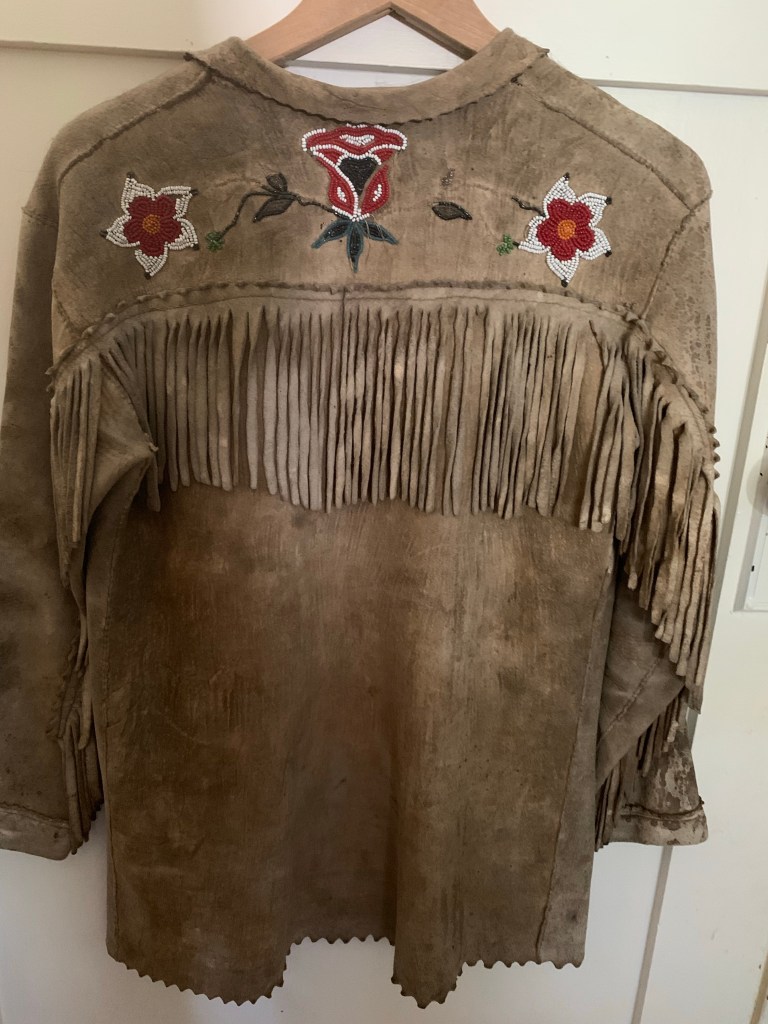
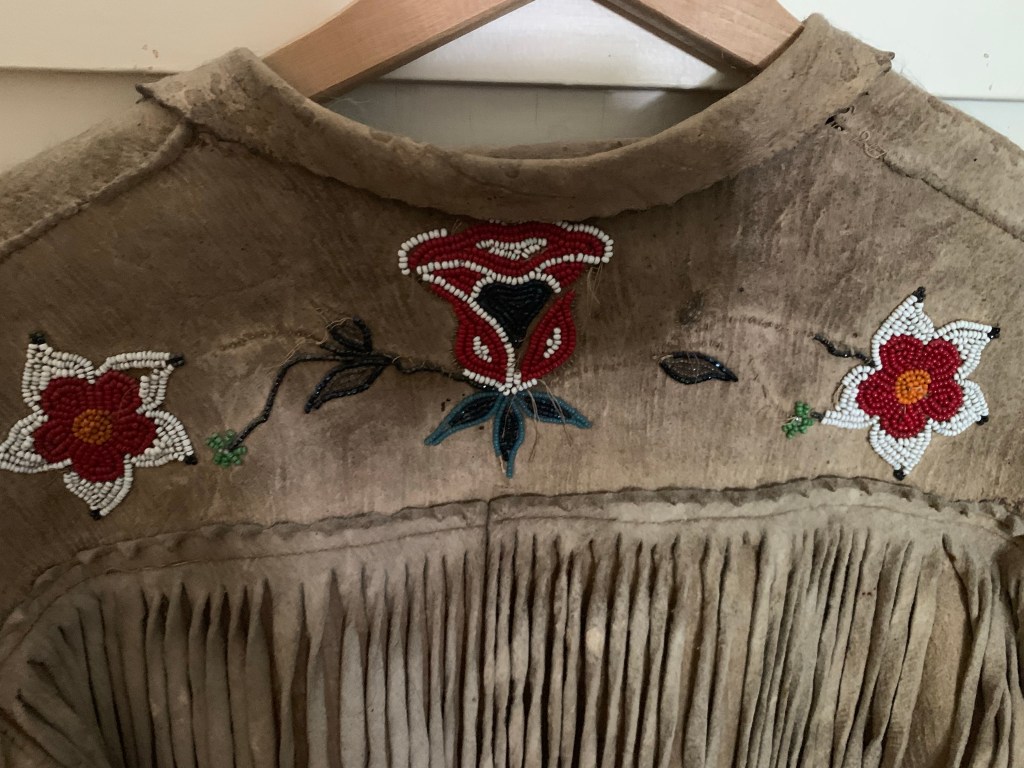
One of my most valued artifacts in this house is a buckskin jacket with beadwork sewn on it. I was told that years ago (waaaay before my time) one of the ladies on the reserve who Grandma was friends with wanted to go to a fancy function but she didn’t have a gown that was appropriate for it. Grandma gave her one of hers so that the woman would be able to go, and never thought much of it again. A while later the buckskin jacket was gifted to Grandma as a thank you for the gift of the gown, and the beads that were hand sewn onto it were taken off of said gown. I look at it daily and it serves me as a reminder of how important it is to live life with an open heart, to give freely, and to receive with gratitude. Again, I try to be sensitive to the words that are used. Grandma only every spoke respectfully of our Indigenous neighbours to the west of us, and so I stayed true to the words written because it was what was used at the time.

The jacket
The beadwork

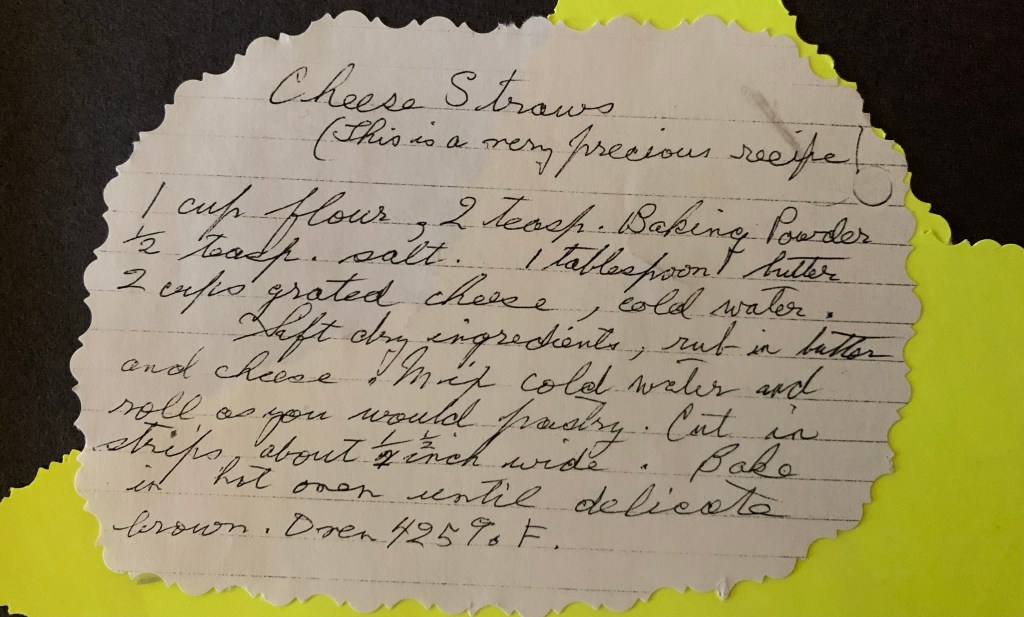
Grandma’s Cheese Straw recipe! My kids grew up eating cheese straws, and they are one of my fondest memories of snack munching as a kid. I agree with her sentiment that it’s a very precious recipe.

All through the years we felt a close tie between us and our neighbours the Indians at Morley. We would contract fencing jobs to them all summer. In the fall they would often help us harvest. And later in November would often ride with the men to help round up stray cattle. I loved our Indian friends and felt I could always trust them. We looked forward to the First of July when they held their annual Stampede in the beautiful natural setting where they had built their corrals. What a magnificent picture to view. We would park our car on the hillside looking down into the corrals, and beyond them the big circle of teepees and tents and their children, cats, and dogs. And back of it all those Gissing blue foothills leading up to the Rockies. Where on earth could you find more beauty and activity? I always felt well entertained. My chickens were just nice fryers by July 1st and I always fried about four or five and along with a salad, cake, and sandwiches that would do us for the day.

My Harry Jacques, the jeweller from Calgary used to have a contest with a prize for the best dressed Indian baby. He very often asked me to be a judge and I wanted so badly to give first prize to everyone there, they were so cute and the beadwork on the buckskin was beautiful. Our kids just loved the first of July and the Morley Stampede.

We always tried to get to Banff or Vermillion crossing for a few days holiday and fishing just before haying. Once we went to Everett, Wash, USA and dug clams just as Percy did when he lived at the coast as a boy.

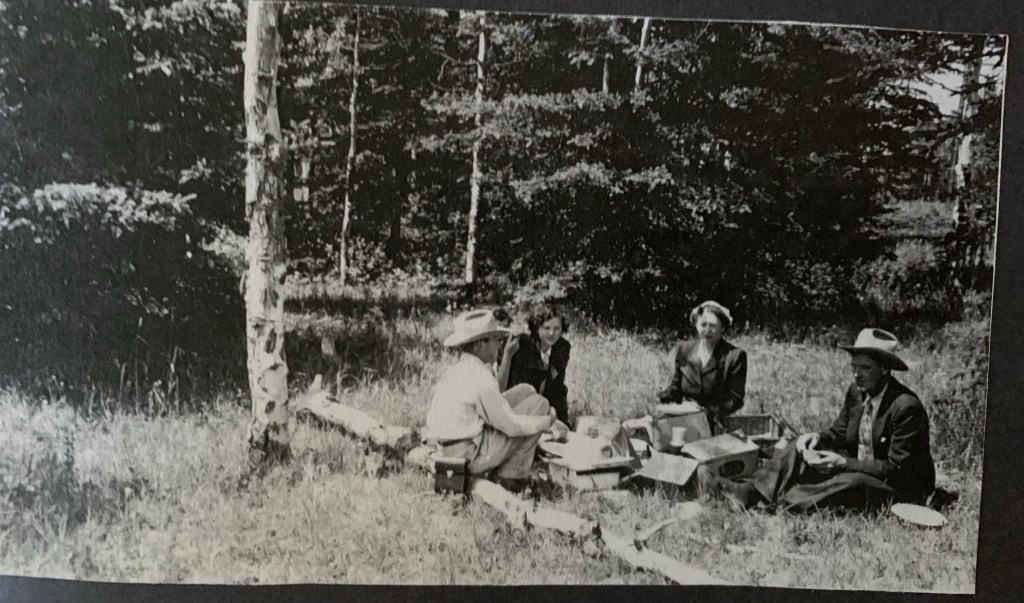
Family fun time
Family picnic at the ranch
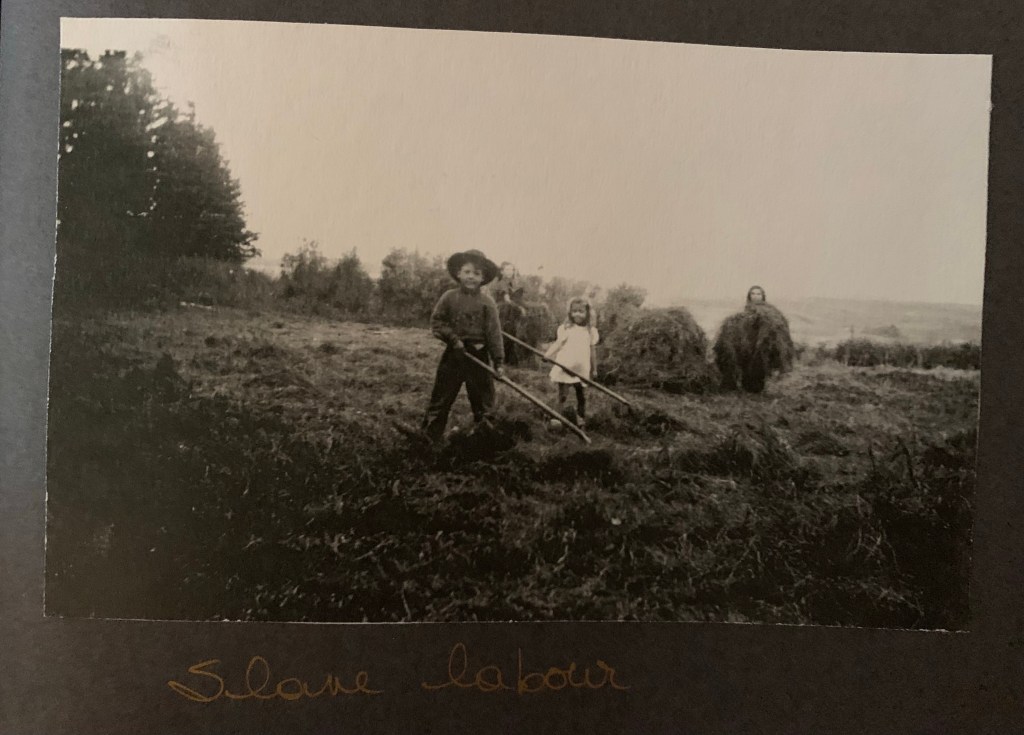
As you can see from the caption “slave labour”. The running joke is that the CL on the brand stands for “Continuous Labour”.
Standard
happiness

Bear in the mountains

We took Bear up to the mountains today. I’ve waited for years to have a dog I can take places – this guy is so chill and happy it’s awesome.

It was a perfect sunny afternoon. As we were walking I realized this was the happiest I’ve been for a long time. For a couple of hours there was no stress, everyone was getting along, and we had the happiest dog in the world. This is what I’m working towards as our normal state of being.

Bear scared of a bear statue.

Standard
happiness

Snow bowl

We decided it was spring like enough outside this afternoon so the girls grabbed their bikes and I grabbed my dog and we went out for a walk.

I love our evening walks, I love listening to the cousins giggle, I love seeing the dog happy, and I love the peace of the country and the mountains. It balances my soul and that brings me to happiness.

The girls found a great little snow bowl drift and stopped for a little rest along the way. They have so much fun together

Standard
happiness

Keeping the faith

I woke up this morning pretty ticked off with God. There’s no nice way to say it, I wasn’t questioning His existence, but rather questioning why He seems to enjoy seeing how much I can take before I break.

Yesterday the boy told me how he felt that his generation hasn’t been raised in the church and he that blamed my generation for that. He said how grateful he was that I’d taken them to church and led them on a path to get to know God.

With that in mind I took my pity party to church this morning in hopes that the sermon would provide me some comfort. It didn’t. It probably annoyed me more than any sermon has in years. Fortunately it was a guest speaker, but I will be happy to not have to hear him again.

I left church still pretty pissy with God. As we came over the hill on our way home and looked out over the ranch and the mountains I stopped the car. I said this is how I know God exists and that he’s not a complete jerk. Look at how beautiful this is, only love could make something so amazing.

Figures since I’ve always found God at the ranch. But it’s not just the place, although it’s very spiritual for me, it’s the people – the tribe – who remind me that God exists in everything.

I stopped by my uncle and aunt’s place to pick up some food for my mom. Watching how my family loves and cares for each other – that’s God stuff, that’s God in the details, that is a reminder that we aren’t walking this journey alone. That is happiness

A photo my dad took of the mountains in the background of the ranch. This is my spiritual happy ground

Standard